
"How many sleeps until my birthday?" "Is five minutes a long time?" "Are we there yet?" If you want to help a child understand time, the first thing to know is that reading a clock is the last step, not the first. Children build a working sense of time years before they can tell you it is 3:45, and the children who arrive at clock-reading with that sense already in place find the clock easy. The ones who do not find it baffling, because the clock is describing something they have never felt. This guide explains how a sense of time develops from toddlerhood to about age eight, and nine everyday ways to build it, none of which involve a worksheet.
How a sense of time develops
Time is one of the most abstract ideas a child ever learns. You cannot see it, touch it or point to it, and the words we use for it (minutes, soon, later, a while) are maddeningly vague. Children assemble it in layers, roughly in this order.
| Age | What they can grasp | What still confuses them | What helps |
|---|---|---|---|
| 2–3 | Sequence: first this, then that. Now vs. not now. | Any duration. "Five minutes" and "an hour" feel the same. | First-then language; a visual timer with color stages; the same routine daily |
| 3–4 | Routine order (breakfast, then school). Yesterday/today/tomorrow, loosely. | Days of the week; "how long" questions | Picture schedules; counting sleeps; short timers they can watch |
| 4–5 | Short vs. long waits; morning/afternoon/night; some days of the week. | Reading any clock; minutes as a unit | Sand and visual timers; "this takes as long as a song" |
| 5–6 | Estimating familiar durations ("a bath is short, a movie is long"); o'clock times. | Half-past and quarter-past; elapsed time | Analog clock in the kitchen; timers for homework and play |
| 6–8 | Reading clocks to 5 minutes; planning "I have 20 minutes." | Time zones, "how long ago," long-term calendars | Letting them set timers; calendars they fill in |
The pattern matters more than the exact ages: sequence first, then duration, then clock. Most of the frustration parents feel around time ("I told you five minutes!") comes from asking a child for a duration skill they do not have yet. The fix is not to explain minutes harder. It is to make time visible until the feel of it develops.

9 everyday ways to build a sense of time
1. Use "first, then" instead of times
"First shoes, then park" gives a two-year-old something they can hold. "We'll go at ten" gives them nothing. Sequence is the foundation of time, and this phrasing teaches it for free, dozens of times a day.
2. Keep routines in the same order
A predictable morning and bedtime routine is a clock a child can feel. When bath always comes before stories and stories always come before lights-out, the child learns "stories means bedtime is near," which is a duration estimate in disguise. A simple picture chart makes the order visible; our toddler bedtime routine chart is one way to do it.
3. Measure time in things they know
"Brushing teeth takes as long as the ABC song." "The drive is three episodes long." Children cannot picture ten minutes, but they can picture a song. Attaching durations to familiar experiences is how adults learned it too.
4. Count sleeps, not days
For anything more than a day away, "three more sleeps" works because a sleep is an event the child experiences. A paper chain with one link torn off each night turns a long wait into something they can watch shrink.
5. Make minutes visible with a timer
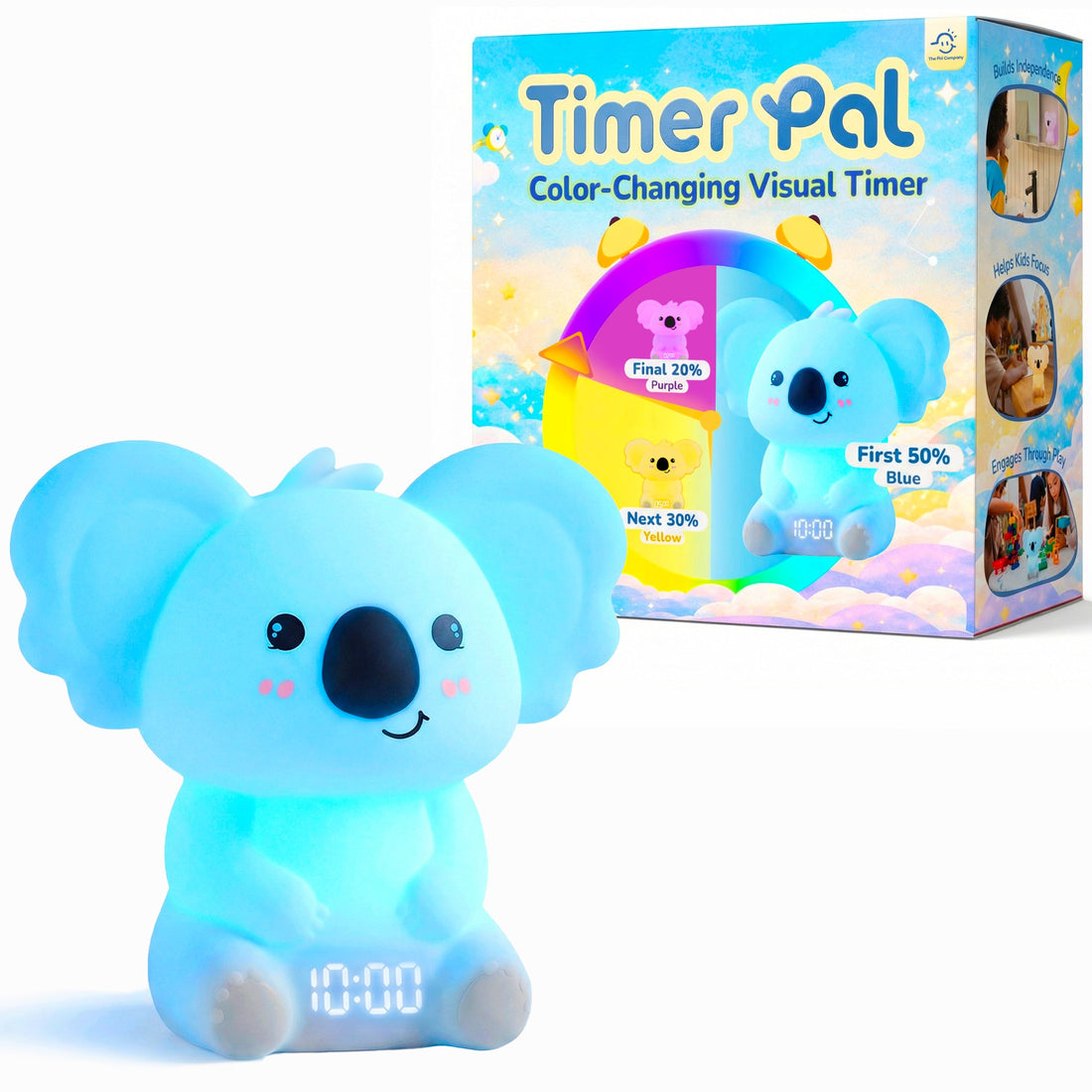
This is the single most useful tool for the duration stage. A visual timer shows time as a shrinking color or shape, so "five minutes" becomes something the child can see and compare: five minutes looks like this much, fifteen looks like that much. Over weeks the child starts to feel the difference without looking. A color-changing timer like the Koala Timer Pal gives toddlers three stages to name (blue, yellow, purple); the free online visual timer for kids does the same on a laptop if you want to try the idea first. Our guide to visual timers for toddlers covers how to introduce one.
6. Let them set the timer
Once a child can read a visual timer, let them set it: "How long do you want for blocks? Set it." Choosing a duration and then living through it is how estimation gets calibrated. A child who asked for twenty minutes and felt it end "too fast" has learned something no explanation could teach. For school-age kids, the homework timer routine builds on exactly this.
7. Narrate the clock before teaching it
Long before a child can read an analog clock, you can point at it: "See the big hand at the top? When it points down, we leave." This builds the idea that the clock moves and that its positions mean something, which is most of what clock-reading is. Keep an analog clock somewhere the child sees it daily; digital clocks show numbers but hide the movement.
8. Talk about time in the past and future
"Remember this morning when we fed the ducks? That was before lunch." "After your nap we'll bake." Casual time talk builds the vocabulary (before, after, earlier, later, soon) that children need before any of the formal concepts land.
9. Give waits an edge
Waiting is where a missing sense of time hurts most. "Wait" with no end is unbearable; "wait until the sand runs out" is a task. Sand timers for short waits and a visual timer for longer ones teach, over and over, that waits end and that you can see the ending coming. Our comparison of sand timers, visual timers and phone timers covers which to use when.

What to avoid
- Explaining minutes to a three-year-old. It is not that they are not listening. The concept has nowhere to attach yet. Show, don't explain.
- Using "in a minute" to mean "later." Children take it literally, and then minutes mean nothing. Say what you mean: "after I finish the dishes."
- Phones as the household clock. A phone shows digits with no movement, and children learn to ask you rather than look. An analog clock and a visual timer teach more by being glanceable.
- Rushing to clock worksheets. If a six-year-old is struggling with half-past, the missing piece is usually the feel of durations, not more practice drawing hands. Go back to timers and routines for a few weeks.
- Treating "are we there yet" as a behavior problem. It is a time-sense problem. Give the trip a visible shape: three songs, two stops, a timer for the last stretch.
A note on children who find time especially hard
Some children take much longer to develop a sense of time, and for some it stays hard into the teen years. Children with ADHD often cannot feel time passing at all, a pattern sometimes called time blindness, and many autistic children experience endings as abrupt even when they were announced. For both groups, the tools above matter more, not less, and the visual timer in particular tends to become a long-term support rather than a stepping stone. Our articles on visual timers for kids with ADHD and visual timers for autistic children go into the specifics.
Frequently asked questions
At what age do children understand the concept of time?
In layers. Sequence ("first, then") from about two; the difference between short and long waits from about four; estimating familiar durations around five or six; and reading a clock to the minute usually between six and eight. A child can have a good working sense of time well before they can read a clock.
How do I teach my child how long a minute is?
Show it rather than explain it. Set a visual timer for one minute and do something during it (hop, sing, brush teeth), then set it for five and compare. Attaching durations to familiar activities ("as long as one song") gives the child a reference they can actually picture.
What is the best way to help a child who can't tell time?
Build the sense of time first: consistent routines, first-then language, counting sleeps, and a visual timer for waits and transitions. Add an analog clock the child sees daily and narrate its movement. Formal clock-reading comes much more easily once durations feel real.
Do visual timers help children learn about time?
Yes. A visual timer turns an invisible duration into a shrinking shape or color, so the child can see what five minutes looks like and compare it to fifteen. Over time they begin to feel durations without the timer. Letting the child set the timer speeds this up.
Should I use a digital or analog clock for my child?
Analog, at least for the house clock. Children learn from watching the hands move and from "when the big hand reaches the top." A digital clock shows numbers without movement and is harder to connect to the feeling of time passing.
Time is learned by feel
You do not need flashcards. You need routines in a steady order, language that names sequence, a few durations the child can picture, and a timer that makes minutes visible until they do not need it any more. Start with the free visual timer for the next wait that comes up, and look at the Timer Pal collection when you want one that lives on the shelf and glows at bedtime.


