
Toddlers do not understand minutes. They understand now, not now, and the unbearable gap between the two. That is why "five more minutes" produces the same meltdown as "we're leaving right now," and why so many parents search for a visual timer for toddlers after a bad week of playground exits. The good news is that a visual timer can work surprisingly early, often from age two, as long as it is the right kind and introduced the right way. This guide covers what to look for at ages two to four, the six daily moments where it helps most, and how to make the timer something your toddler reads rather than resists.
What a toddler can and cannot understand about time
Between two and four, children are building the idea that time passes at all. They can grasp sequence ("first shoes, then park"), and they can notice that something is changing: a light getting dimmer, a color shifting, sand running down. What they cannot do is read numbers, estimate how long five minutes is, or hold an abstract warning in mind while they play. So a timer for this age has to do the remembering for them, visibly and continuously, with no reading required.
That rules out most timers adults use. A phone shows digits. A kitchen timer shows a dial and then screams. Even a classic disc timer asks a two-year-old to understand that a shrinking wedge means shrinking time, which is a stretch for many until closer to four. What works instead is a timer whose whole appearance changes in stages a toddler can name.

What to look for in a toddler visual timer
| Feature | Why it matters at 2–4 | What to avoid |
|---|---|---|
| Color stages, not numbers | "Blue, then yellow, then purple" is a story a toddler can follow | Digits, dials, wedges that need explaining |
| Silent countdown | Toddlers tune out ticking and get wound up by it | Mechanical ticking |
| Gentle ending | A fade keeps the mood; an alarm starts the tantrum | Loud beeps or rings |
| Visible in the dark | Bedtime is the big use at this age | Anything unreadable with lights off |
| Toddler-proof body | It will be carried, dropped and hugged | Glass sand timers, thin dials |
| Short settings available | Two- and three-minute waits are the daily reality | Timers with a 5-minute minimum |
| Friendly shape | A face earns trust faster than a gadget | Anything that looks like it belongs in a kitchen |
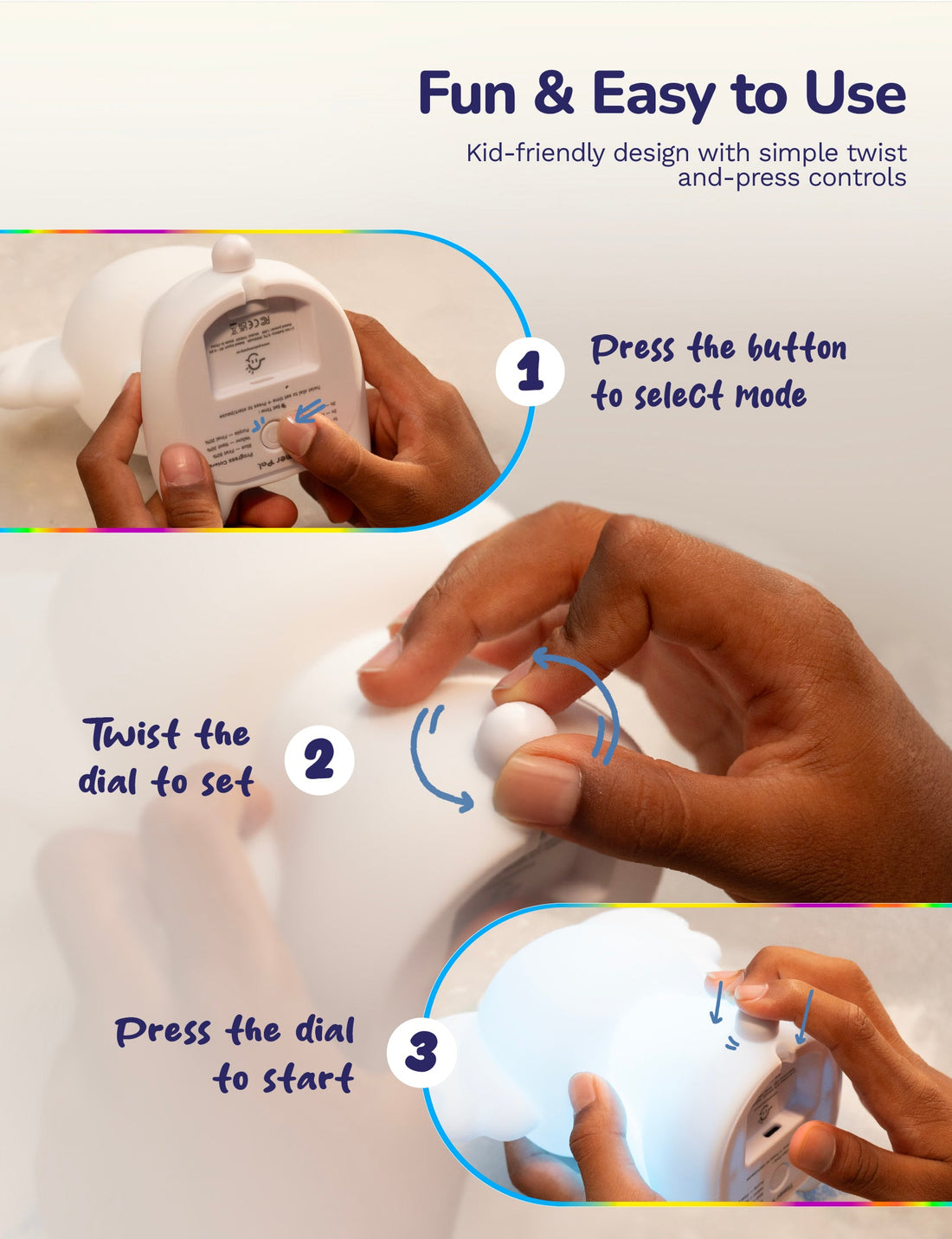
Character timers were designed for exactly this stage. The Koala Timer Pal glows blue at the start, turns yellow at halfway and purple for the last stretch, with no sound, a soft fade at the end, and a body that survives being carried around the house. Twist to set anything from one minute up, press to start. If your toddler is on the older end and likes watching bars shrink, the Rainbow Timer Pal shows the countdown as light strips going out one by one, which three- and four-year-olds often find fascinating.
The 6 toddler moments a visual timer helps most
- Leaving somewhere fun. The playground, grandma's, the splash pad. Set the timer where your toddler can see it when you arrive, say "when it's purple, we go," and point at each color change. The ending stops being your fault.
- Screen time. A show that ends when the light fades rather than when a parent grabs the remote. Pair it with the scripts in our guide to ending screen time without a meltdown.
- Waiting. For a turn, for a snack, for a sibling. Two minutes on a visual timer gives "wait" an edge a toddler can see, which is the whole difficulty with waiting.
- Tooth-brushing. Two minutes is forever to a toddler. A timer that changes color turns it into "brush until it's purple," and many children start watching the timer instead of fighting the brush.
- The bedtime wind-down. Set it for the last ten or fifteen minutes of the routine, with the lights low. When the light fades, it is lights-out, and your toddler watched it coming. This stacks neatly with a toddler bedtime routine chart for the steps before it.
- Quiet time and early mornings. For toddlers dropping their nap, a timer for "quiet time in your room" shows how long it lasts. For early risers, a color timer can act as a simple first step before a full ok-to-wake clock.
How to introduce a visual timer to a toddler
The timer will fail if its first job is the hardest transition of the day. Toddlers need the timer to mean good things before it can mean endings. This sequence takes about a week.
Days 1–2: it's a toy
Leave the timer within reach. Let your toddler twist it, press it, watch it change. Narrate the colors without attaching anything to them: "Look, it's yellow now. Now purple!" No demands.
Days 3–4: it predicts fun
Use it only for transitions into something your toddler likes. "When it's purple, we go outside." "When the light finishes, bath bubbles." Three or four of these and the timer is a bringer of good news.
Days 5–7: one real ending
Pick one everyday ending, ideally a mild one like finishing a snack or leaving the bath. Set a short timer, point at halfway, point at "almost purple," and follow through calmly when it ends. Expect some protest the first time; the second and third are usually smaller.
After that: let them press start
A toddler who starts the timer feels like the boss of it. "You press it!" costs nothing and buys a lot of cooperation.

Five things that make toddler timers backfire
- Long countdowns. Twenty minutes on a timer a toddler does not yet trust is just a long, visible threat. Start with two to five minutes.
- Negotiating. "Okay, two more minutes" after the timer ends teaches that purple is the start of a conversation. If you want to be generous, add the minutes before you press start.
- Using it only for bad news. If the timer only ever means "stop," your toddler will learn to hide it. Keep using it for fun endings too.
- Talking over it. A toddler cannot process a running commentary. Two short cues ("halfway," "almost purple") and then quiet.
- Expecting it to fix the transition. The timer gives warning. What happens next, your calm, the hand to hold, the thing to carry to the car, is still yours to plan.
Toddlers who find transitions unusually hard, including many autistic toddlers, often respond especially well to a visual timer once it is introduced slowly. Our guide to visual timers for autistic children goes deeper on pairing the timer with first-then language.
Try it before you buy it
You can test the whole idea this afternoon with our free visual timer for kids: it runs in a browser, shows a color countdown with no numbers, and needs no app or login. Set it for "two minutes until we tidy up" and watch whether your toddler glances at it. If they do, a screen-free timer from the Timer Pal collection is the version that can live on the shelf, go in the stroller, and glow in the dark at bedtime.
Frequently asked questions
At what age can a toddler use a visual timer?
Many toddlers begin around age two, as soon as they can notice a color or light changing and connect it to "almost time." At this age the adult reads the timer aloud; by three or four, most children read the color stages themselves and will start the timer on their own.
What is the best visual timer for a 2-year-old?
A silent, color-changing timer with a friendly shape and a gentle ending. Look for clear stages a toddler can name (for example blue, yellow, purple), no ticking, no alarm, a sturdy body, and settings as short as one or two minutes. Avoid digit timers, kitchen timers and glass sand timers.
How long should I set a timer for a toddler?
Short. Two to five minutes for waits and small endings, up to ten or fifteen minutes for play and the bedtime wind-down. Lengthen only once your toddler is reliably reading the timer and transitioning calmly at the shorter settings.
My toddler cries when the timer ends. Should I stop using it?
Not necessarily. Protest at the ending is normal in the first few uses, especially if the timer was introduced on a hard transition. Go back to using it for fun endings for a few days, keep countdowns short, and make sure the end is a quiet fade, not an alarm. If distress continues over weeks, talk with your pediatrician about other transition supports.
Is a visual timer the same as an ok-to-wake clock?
No. A visual timer counts down a set number of minutes; an ok-to-wake clock turns a color at a set time of day. Toddlers often use both: the timer for daytime transitions and the wind-down, the clock for mornings. Many families start with the timer because it is useful all day.


