
It's 5:14 a.m. You hear the door creak, then the soft pat-pat-pat of little feet, and suddenly there's a small face two inches from yours announcing, with total confidence: "It's morning time!"
It is not morning time.
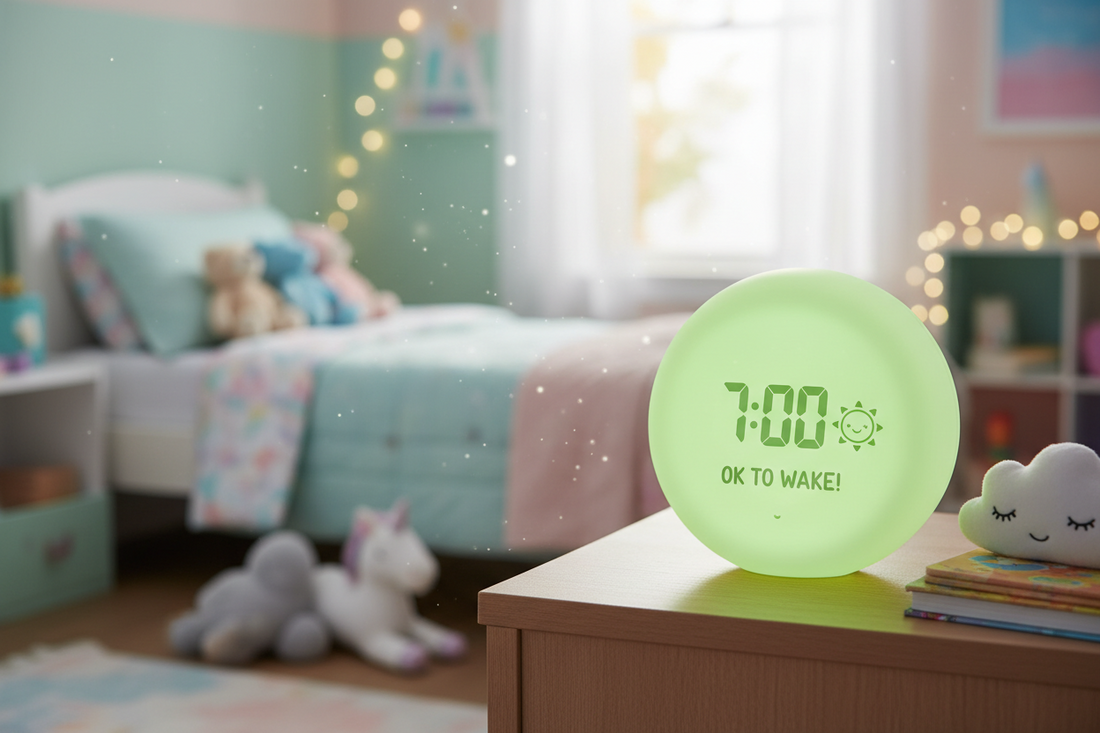
If your toddler treats 5 a.m. like the start of the party, you've probably already Googled your way to the same answer thousands of exhausted parents find every night: an OK-to-wake clock. The idea is beautifully simple — the clock (or light) changes color at a time you choose, and your child learns to stay in their room until they see the "wake-up color."
But then come the real questions. What age can a kid actually understand this? Why does it work like magic for some families and get completely ignored in others? And what do you do when your two-year-old decides the green light is merely a suggestion?
Let's walk through it — age by age, step by step, including the troubleshooting nobody puts on the box.
First, What an OK-to-Wake Clock Actually Does
An OK-to-wake clock isn't really a clock at all — at least not from your child's point of view. Young kids can't read time, and even "wait until 6:30" is meaningless to a brain that experiences time as now and not now.
What the clock does is translate time into something a toddler can read: color. Red (or amber, or off) means "still sleeping time." Green (or another wake color) means "you can come out." That's the whole system. It works for the same reason visual timers work for daytime routines — it makes an invisible thing visible, so your child doesn't have to guess, and you don't have to be the referee at dawn.
One honest note before we go further: an OK-to-wake clock does not make a child sleep longer. It teaches a child what to do when they wake up before wake-up time. That distinction matters, because it tells you what success looks like — a kid who wakes at 5:40, looks at the light, and quietly waits (or plays) in their room until it turns green. The extra sleep often comes later, as a bonus, once early waking stops being rewarded with company and Cheerios.
What Age to Start: An Age-by-Age Guide
"What age does an OK-to-wake clock work?" is really two questions: when can you introduce one, and when will it reliably work. Here's how it tends to break down.
Under 2: Not yet — but you can set the stage
Most children under two simply don't have the impulse control or rule-following ability to act on a color cue, and a child still in a crib doesn't need one — the crib is doing the containing. If you buy a wake-up light early, use this stage to build positive associations: it's simply the cozy light that's part of the bedtime routine. No rules, no expectations. A soft, red-toned glow at bedtime is a gentler choice than bright white or blue light in the evening hours.
Ages 2–3: The introduction window
Somewhere between 2.5 and 3 is when most families can genuinely start. Good signs your child is ready: they've moved to a toddler bed (or climb out of the crib anyway), they can follow simple two-part instructions, and they understand conditional rules like "when the light is green, you can come out."
Keep expectations gentle here. A just-turned-two-year-old following the light on day three is the exception, not the rule. At this age you're planting the routine, celebrating every small success, and expecting plenty of do-overs.
Ages 3–5: The sweet spot
Preschoolers are rule-lovers. This is the age when OK-to-wake systems tend to click — kids this age are often proud to announce "I waited for the green light!" They're also old enough to pair the light with a simple morning plan: stay in your room, look at books or play quietly in bed, and come out when the light changes.
Ages 5–8: Independence mode
Older kids may not need the color cue to stay in their room — but the light earns its keep in new ways: protecting weekend mornings, giving an early bird a clear signal for when it's okay to turn on the light and read, and keeping a younger sibling's schedule from being run by the older one (or vice versa).
How to Actually Make It Work: 7 Steps
Plenty of wake-up clocks end up in the donation box not because the idea failed, but because the setup did. Here's the sequence that gives it a real chance.
1. Start with the wake time your child already has
This is the mistake that sinks most families in week one. If your child wakes at 5:30, don't set the wake light for 7:00 — you're asking a toddler to wait ninety minutes on day one, and they will (reasonably) conclude the light is broken or irrelevant. Set it for 5:30 or 5:45 first. Let them win. Then shift it later by 10–15 minutes every few days until you reach a wake time everyone can live with.
2. Practice during the day, not at dawn
Introduce the clock in the afternoon, when everyone is fed and regulated. Make it a game: "Let's pretend to sleep! When the light turns green — jump up!" Run the drill three or four times with lots of giggling. A rule rehearsed in daylight has a fighting chance at 5:40 a.m.; a rule explained for the first time at bedtime does not.
3. Make the rule about the room, not about sleep
You cannot make a child sleep — and "go back to sleep" is a losing battle. The rule is simpler: until the light changes, we stay in our room. Awake is allowed. Quiet play is allowed. What changes is that waking early no longer means waking you early.
4. Build a quiet-time basket
Give the rule something to lean on: a small basket of books and quiet toys your child may only touch during before-the-light time. Rotate it weekly so it stays interesting. For early risers who want to know how much longer, a visual timer can sit right next to the wake light — our Timer Pal shows remaining time as a shrinking colored disk, so "how long until green?" has an answer a four-year-old can see, no clock-reading required.
5. Respond the same way every single time
The make-or-break ingredient. If your child appears at your bedside before the light changes, walk them back — calm, boring, brief: "The light's not green yet. You can look at your basket." The fourth walk-back at 5:50 a.m. is where the routine is actually built. If coming out early sometimes earns snuggles and cartoons, your child will run that experiment forever (they're excellent scientists).
6. Celebrate like it's a big deal — because it is
The first morning your child waits for the light, respond like they scored a goal: specific praise, a big hug, maybe a sticker. "You waited for green all by yourself!" Kids repeat what gets noticed.
7. Never use the light as a punishment
The light is information, not a warden. "If you get out of bed again, I'm setting the light later!" teaches your child the light is the enemy — and the whole system runs on the light being a friend.
Troubleshooting: When the Light Gets Ignored
"My child just ignores it." Usually one of three things: the wake time is set too far past their natural waking (see step 1), the rule wasn't practiced in daylight, or coming out early still pays off sometimes. Fix the easiest one first and give it two weeks of consistency before you call it.
"They wake at 5 a.m. no matter what." A wake light can't fix a schedule problem. Check the basics: is the room dark enough (blackout curtains are the unsung hero of toddler sleep), is bedtime so late they're overtired, or so early they're simply done sleeping? If very early waking persists no matter what you try, it's worth mentioning at your next pediatrician visit.
"Bedtime is the real battle." The morning light works best when the evening routine is calm to begin with. A predictable wind-down — bath, books, dim light, cuddle — signals the body that sleep is coming. This is the half of the day our Slumber Pal was made for: a squishy, tap-to-use night light with a warm red-light mode that's gentler for evenings than bright white or blue light, and a 30-minute auto-off so it tucks itself in after your child drifts off. (We'll be honest: Slumber Pal is a wind-down companion, not an OK-to-wake clock — think of them as the evening shift and the morning shift.)
"It worked, then stopped." Totally normal — regressions happen after travel, illness, a new sibling, or dropping a nap. Go back to basics: re-practice the game, temporarily set the wake time earlier so they can win again, and rebuild from there.
A Word on Keeping Mornings Screen-Free
It's tempting to solve early waking with a tablet — and we get it, 5 a.m. is desperate territory. But screens in the pre-dawn dark are a trade that tends to cost more than it pays: they're stimulating exactly when you want calm, and they turn early waking into something worth waking up for. A color cue, a basket of books, and a visible timer ask more of your child at first — and give back a kid who can start the morning on their own steam. That no-screens, no-apps simplicity is the hill we happily live on as a company: one button, one job, nothing to scroll.
Start Tonight, Win by September
Here's the two-week version: pick a wake color and rehearse it as a game today, set the wake time to match your child's actual wake time tonight, stock the quiet basket, walk them back (boringly) every early appearance, and shift the wake time later in small steps as they succeed. Most families who hold the line for two or three weeks come out the other side with mornings that start with a green light instead of a 5 a.m. ambush.
And if big feelings show up along the way — at bedtime, at wake-up, or anywhere in between — try our free interactive calming tools at palcompany.co/pages/playground: guided breathing and soothing visuals your child can try right now, no downloads, no apps, no signup.


