
Homework time in a lot of houses sounds like this: "Have you started?" "Start." "Why aren't you working?" "Ten more minutes." "That's not working." A visual timer for homework does not make the worksheet more interesting, but it does take you out of the role of human alarm clock, and it gives your child something they rarely get with homework: a clear picture of when it will be over. This guide lays out the 25-minute routine we recommend, how to shorten it for younger kids, and the handful of mistakes that make timers backfire.
Why homework fights are really about time
Ask a child why they will not start their homework and you will hear "it's boring" or "I don't know how." Both can be true, but underneath is usually something simpler: the task has no visible end. "Do your homework" could mean ten minutes or two hours as far as a nine-year-old can feel it, and an open-ended unpleasant thing is very hard to start. Adults handle this by glancing at the clock and doing arithmetic. Many children cannot yet do that arithmetic in their heads, and children with ADHD often cannot feel time passing at all, a pattern we cover in our article on visual timers and ADHD.
A visual timer solves the "no visible end" problem directly. The child sees a block of time that is clearly finite, watches it shrink, and knows a break is coming at a specific, visible moment. Three things change almost immediately:
- Starting gets easier, because "work until the light is purple" is a smaller ask than "work until it's done."
- You stop nagging, because the timer is the one deciding when the block ends, and the child can check it without asking you.
- Breaks become real, which means the child stops taking unofficial breaks every ninety seconds.

The 25-minute homework routine
This is a child-sized version of the Pomodoro technique, which adults have used for decades: a fixed work block, a short break, repeat. Twenty-five minutes suits most kids from about age ten; younger children use shorter blocks, which we cover in the next section. Here is the routine in full.
- Set up before starting the timer. Water, pencil, the actual pages open. Setup is not work time. If setup happens inside the block, the child learns to spend the block sharpening pencils.
- Name one thing for this block. "This block is the math sheet." Not "homework." One block, one task. If it finishes early, the child reads or starts the next task; the block still runs to the end.
- The child starts the timer. Not you. Starting the timer is the moment of commitment, and children who press the button themselves argue far less about the block than children who had it pressed on them.
- Work until the timer finishes. You do not interrupt, check, or ask how it is going. If the child asks for help, help, but keep it short; the timer keeps running.
- Take a real 5-minute break, timed. Up, away from the table, no screens. Set the timer for the break too. The break is what makes the next block possible, and a visible break is one the child trusts will actually happen.
- Repeat, up to three blocks. Most homework for kids under twelve fits in one or two blocks. If it routinely needs four, that is a conversation with the teacher, not a timer problem.
- End with a check and a close. Pages in the folder, folder in the bag. The routine ends with something done, not with the timer running out mid-sentence.
Work and break lengths by age
Twenty-five minutes is too long for a seven-year-old. Attention spans grow with age, and the point of the block is to be achievable: a block the child can finish every time is worth more than an ambitious one they fail at half the time. Use these as starting points and adjust up only once a child is finishing blocks comfortably.
| Age | Work block | Break | Blocks per evening | Notes |
|---|---|---|---|---|
| 5–6 | 8–10 min | 5 min | 1–2 | Mostly reading together; the timer teaches the idea of a block |
| 7–8 | 10–15 min | 5 min | 1–2 | Child starts the timer; parent nearby but not hovering |
| 9–10 | 15–20 min | 5 min | 2 | Child names the task for each block |
| 11–12 | 20–25 min | 5 min | 2–3 | Full 25-minute routine; child runs it alone |
| 13+ | 25–30 min | 5–10 min | 2–4 | Timer becomes a study tool the teen chooses to use |
For children with ADHD or who are easily frustrated, go one row shorter than their age suggests and lengthen slowly. A visual timer matters even more here, because the child can see the block is short and ending, which is exactly the reassurance that gets them to start.
Which timer works best for homework
Any visual timer is better than a phone, which is also a games console, a messaging app and a camera. Beyond that, three features help with homework specifically:
- Silent countdown. Ticking is distracting at a desk. A silent light or disc is better.
- Visible from the page, not just from across the room. The child should be able to glance up without turning around.
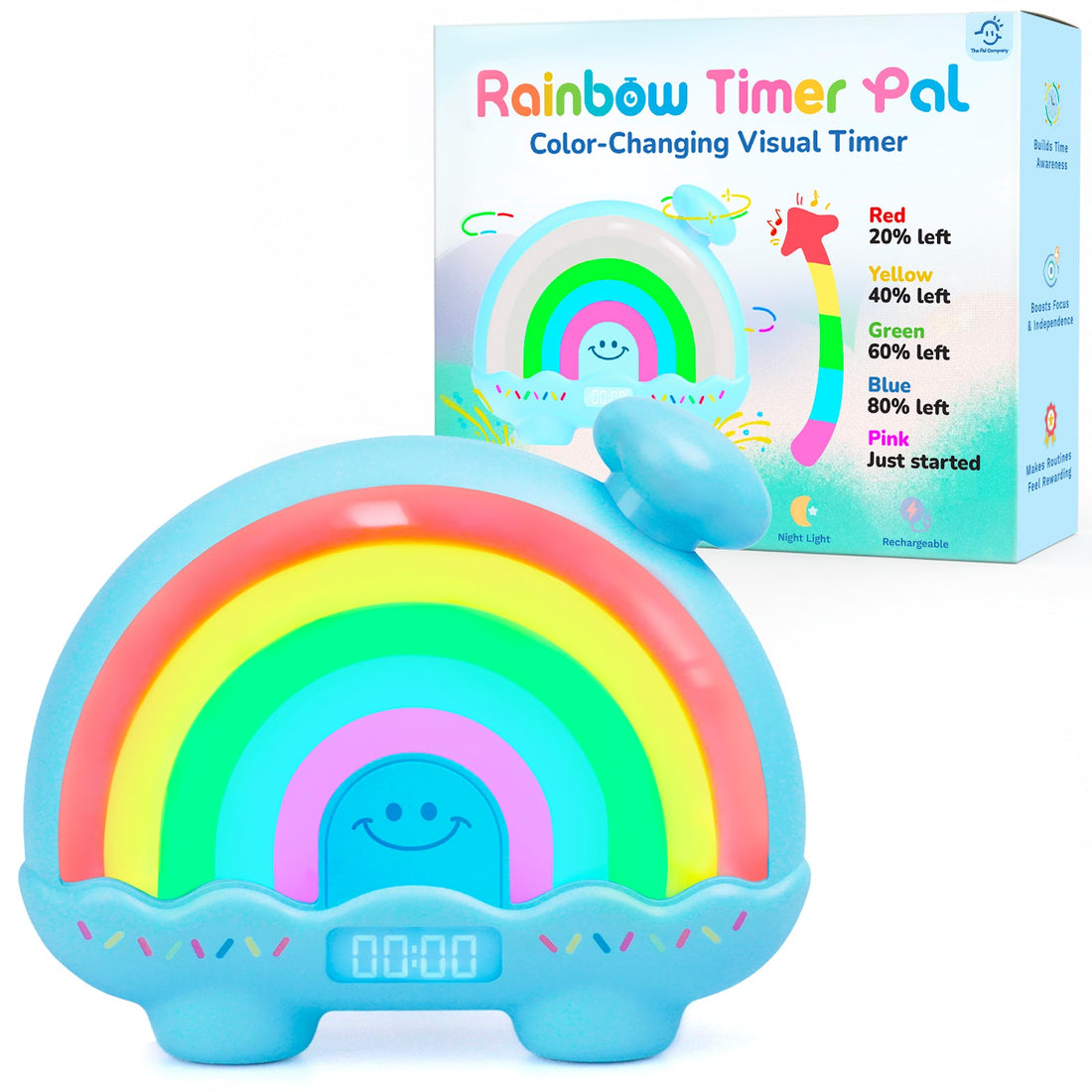
- Settable by the child. A twist-to-set dial with 1 to 99 minutes, like the Rainbow Timer Pal, lets the child set work and break blocks themselves, which is the whole point of step three.
If you are not sure the routine will stick, run it for a week with our free online visual timer on a laptop at the far end of the table. It is silent, it needs no account, and it tells you quickly whether a visible countdown changes anything for your child. Once it does, a screen-free timer from the Timer Pal collection removes the laptop, and with it the temptation to "just check one thing." Our round-up of Time Timer alternatives compares the main types if you want to see the options side by side.

Five mistakes that make a homework timer backfire
1. Using the timer as a threat
"You have 25 minutes to finish or no TV." Now the timer is a countdown to punishment and the child will race, rush, and resent it. The block is a container for effort, not a deadline for output. What gets finished in the block gets finished; what does not goes in the next block.
2. Interrupting the block
Every "how's it going?" resets the child's focus. If you need to check work, do it at the break. If you cannot resist, leave the room.
3. Skipping the break
"You're on a roll, keep going." The child learns that breaks are not real, and the next block starts with a fight. Breaks are part of the routine, not a reward for it.
4. Adding minutes mid-block
If the block runs out before the page is done, the block still ends. Changing the timer teaches the child that the timer is negotiable, and a negotiable timer is just you with extra steps.
5. Starting at the hardest time of day
Straight after school, most kids are depleted. Snack and twenty minutes of movement first, then the first block. The timer works far better on a child who has eaten.
What to expect in the first two weeks
Week one is usually bumpy. The child tests whether the block really ends when the timer does (it should), whether the break really happens (it should), and whether you will interrupt (do not). By the second week, most families notice the thing they were hoping for: homework starts without a speech, and the evening gets its temperature back. The child is not more motivated. They just know when it ends.
Frequently asked questions
How long should a homework timer be set for?
Start with roughly one to two minutes of work per year of age, so 10 minutes for a 7-year-old and 20 to 25 minutes for an 11- or 12-year-old, followed by a 5-minute break. Lengthen the block only once the child is finishing it comfortably most days.
Does a visual timer help kids with ADHD do homework?
For many children it may help considerably, because ADHD often involves difficulty sensing time passing. A visual timer shows a short, shrinking block, which makes starting easier and makes the break feel real. Use shorter blocks than the age chart suggests and let the child start the timer themselves.
What if my child finishes before the timer ends?
The block still runs. The child can check their work, read, or begin the next task. Ending blocks early teaches rushing; running them to the end teaches that the block is a fixed container for effort.
Should I use the timer for the break as well?
Yes. A timed, visible break is one the child trusts will end fairly, which means less pleading for "one more minute." Set it for 5 minutes, away from the table and away from screens.
Is a phone timer okay for homework?
It works for some teenagers, but for most children a phone on the desk is a distraction that happens to have a timer on it. A standalone visual timer shows the remaining time as a shape or color the child can glance at, and it cannot open a game.
Start tonight with one block
Do not overhaul the whole evening. Pick one subject, set one short block, let your child press start, and leave the room. Tomorrow, add the break. By the end of the week the routine will have a shape, and homework will have an ending your child can see. The free visual timer is enough to begin; when you are ready for one that lives on the desk instead of the laptop, the Timer Pal collection is the next step.


