
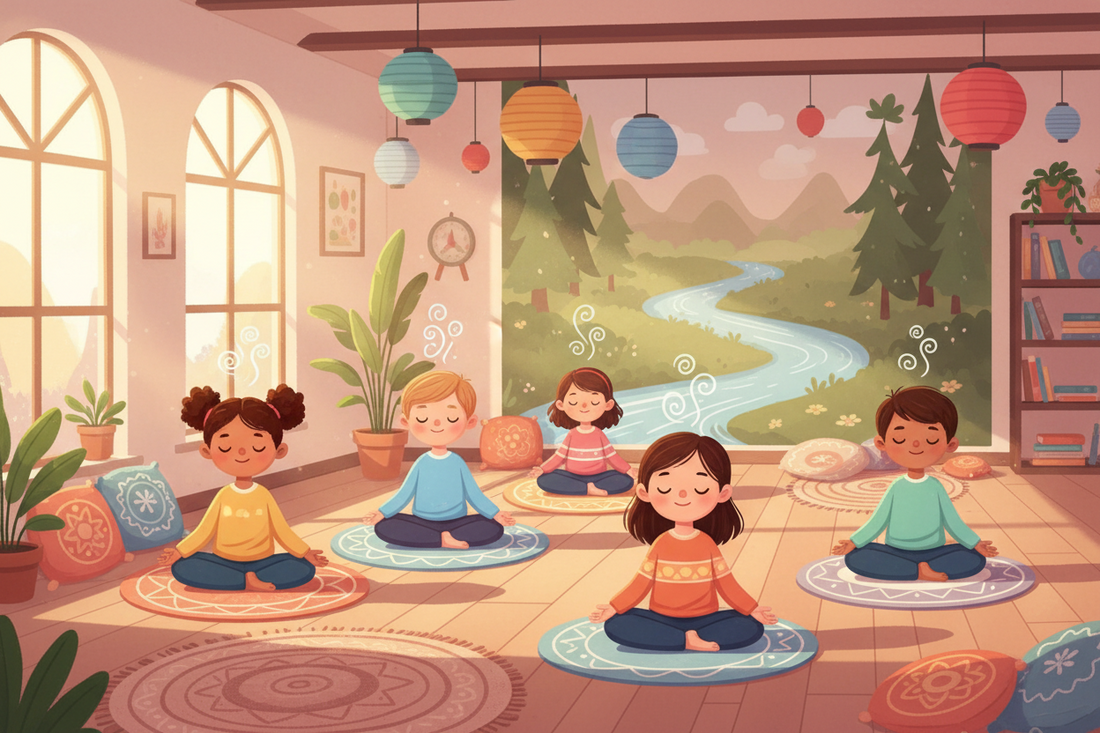
Your child is melting down in the cereal aisle, or frozen at bedtime, or crumpled over a math worksheet — and someone, somewhere, has told you the answer is "just have them take a deep breath." If only. Anyone who's tried to coach a dysregulated four-year-old to "breathe deeply" knows how that goes: they either ignore you, gulp air like they're about to dive underwater, or look at you like you've grown a second head.
Here's what that advice leaves out. "Take a deep breath" is not one skill — it's a whole family of them, and the version that calms a toddler is completely different from the one that helps an eight-year-old fall asleep. The trick isn't more breathing. It's the right breathing, taught the right way, for the age your child actually is.
Below are three of the most reliable, kid-tested breathing techniques — box breathing, rainbow breathing, and 4-7-8 breathing. For each one you'll get the sweet-spot age range, a simple script for teaching it, and the common snags that trip families up (plus how to fix them). None of this requires an app, a subscription, or a screen. Just you, your child, and a little practice.
First, why breathing actually works (the 20-second version)
When a child is upset, their nervous system flips into fight-or-flight: fast heart, shallow breath, big feelings, no logic. You can't reason a body out of that state — but you can breathe it out. Slow breathing, especially a long exhale, gently signals the body's calming system that the danger has passed. The heart rate settles, the shoulders drop, and the thinking brain comes back online.
That's the whole mechanism. A long, slow out-breath is the off-switch for panic. Every technique below is just a kid-friendly way to stretch that exhale out — with enough structure that a young child can actually follow along.
One important note before we start: these tools help kids manage everyday big feelings, and they may help support children who feel anxious or have trouble winding down. They're a wonderful life skill for every child. They are not a treatment for a diagnosed condition, and if you're worried about your child's anxiety or mood, a pediatrician or child therapist is the right first call.
Rainbow Breathing (best for ages 2–5)
Rainbow breathing is the gentlest on-ramp, which is why it's the go-to for toddlers and preschoolers. There's no counting, no holding, and no abstract shapes — just an arm tracing a rainbow through the air while breath follows along. For little kids who can't yet hold a number in their head, the movement is the instruction.
How to teach it:
Sit or stand beside your child, not across from them, so you're moving together. Then walk through it in your warmest, slowest voice:
"Let's paint a rainbow with our breath. Start down here by your knee. Breathe in through your nose as your hand goes up and over the top — smell the flowers on the way up. Now breathe out slowly through your mouth as your hand floats down the other side — blow out the candle as you come down. Let's paint another color!"
Do it three or four times, one "color" per breath. The up-and-over arc naturally paces the breath: rising for the inhale, falling for the exhale. Because the exhale rides the slow "floating down" motion, kids stretch it out without even trying.
Common snags and fixes:
The biggest one is that little kids race through it, whipping their arm around like a windmill. Slow your arm way down and exaggerate the motion — they mirror you, so your pace sets theirs. If "smell the flowers, blow out the candle" doesn't land, try "smell the cookie, cool the soup." And don't expect a dysregulated toddler to breathe on command; teach rainbow breathing during calm, happy moments first — in the bath, at bedtime, waiting for dinner — so it's a familiar game long before you need it in a hard moment.
You can practice the "smell the flower, blow the candle" rhythm together at our free interactive playground, which gives kids an on-screen visual to follow along with — a low-key way to make the motion feel automatic before the next tantrum hits.
Box Breathing (best for ages 6–10)
Box breathing — sometimes called square breathing — adds one new ingredient toddlers aren't ready for: the hold. You breathe in for a count of four, hold for four, breathe out for four, hold for four, tracing the four sides of a square. That gentle structure gives school-age kids something concrete to focus on, which is exactly why it's a favorite in classrooms and on sports sidelines.
How to teach it:
The magic here is making the square visible. Draw a square in the air with your finger, or better yet, have your child trace one on their own palm, on a windowpane, or along the edge of a book. One side per phase.
"We're going to breathe around a square. Trace the first side up while you breathe in — one, two, three, four. Now trace across the top and hold your breath — one, two, three, four. Trace down the other side and breathe out — one, two, three, four. Now across the bottom and hold — one, two, three, four. Around we go again."
Four rounds is plenty. Counting slowly (about one number per second) keeps it from becoming a race.
Common snags and fixes:
The hold is where kids struggle. Some panic a little at holding their breath, and others hold so hard their shoulders climb up to their ears. If the hold causes stress, drop it entirely at first — just do "in for four, out for four" until the rhythm feels safe, then add the pauses back in. Keep the counts short; a four-count that's too slow leaves kids gasping, which defeats the purpose. And watch for chest-heaving. Real calming breath comes from the belly, so have them rest a hand on their tummy and feel it rise like a balloon on the inhale. A physical anchor helps enormously here — many kids do better tracing the sides of a slow-glowing Breathing Pal, whose light expands and shrinks so they can see the pace instead of trying to hold four numbers in their head. Watching a light breathe with them takes all the guesswork out of "am I doing it right?"
4-7-8 Breathing (best for ages 8+)
The 4-7-8 method — inhale for four, hold for seven, exhale for eight — is the most advanced of the three, and the most powerful for winding down. That extra-long, eight-count exhale is a deep calming signal, which makes 4-7-8 a genuinely effective bedtime and pre-test tool for older kids and tweens. But those longer counts and the seven-second hold ask for lung capacity and self-control that younger children just don't have yet, so save this one for around age eight and up.
How to teach it:
Older kids can handle a straight explanation, but it still helps to frame it as a tool that's theirs to control, not something being done to them.
"This one's a bedtime superpower. Breathe in quietly through your nose for four. Hold it — seven counts, nice and easy. Now let it all out through your mouth for eight, like you're fogging up a mirror or blowing through a straw. That long breath out is the part that makes your whole body sleepy. Let's do four rounds."
Four cycles is the standard dose. Have them place the tip of the tongue just behind the front teeth on the exhale if they like the classic version — but honestly, the long exhale is what matters most.
Common snags and fixes:
The seven-count hold is genuinely hard, and a lot of kids run out of air on the eight-count exhale at first. Scale it down and keep the ratio, not the exact numbers: try 2-3-4, then 3-5-6, then work up to 4-7-8 over a couple of weeks. If your child gets lightheaded, they're pushing too hard — remind them the breaths should feel easy, almost lazy, never strained. And because 4-7-8 is so relaxing, it's not the right tool for the middle of a heated tantrum, when a kid can't sit still enough to count to seven; it shines in the calm-down after, and especially at bedtime as part of a wind-down routine.
Which one, when? A quick cheat sheet
You don't have to pick just one — most families end up with a small toolkit. As a starting point:
- Ages 2–5: Rainbow breathing. Movement-based, no counting, plays like a game.
- Ages 6–10: Box breathing. Structured and visual, great for school-day resets and worry.
- Ages 8 and up: 4-7-8 breathing. The long exhale makes it the bedtime and pre-test champion.
- Any age, in the moment: Whatever your child already knows cold. A meltdown is not the time to teach a new skill — it's the time to reach for the familiar one.
That last point is the one to underline. Breathing techniques only work in a crisis if they're already automatic, and they only become automatic through calm, low-stakes practice. Ten seconds at bedtime, a round while waiting in the car, a "let's paint a rainbow" before a birthday party — those tiny reps are what make the skill available when the big feelings actually arrive.
Make practice a habit, not a lecture
The families who succeed with breathing tools aren't more disciplined — they've just made practice effortless and even fun. Tie it to something you already do daily: three rainbow breaths before dinner, a round of box breathing after homework, 4-7-8 as the last step of the bedtime routine. Keep sessions short. Praise the effort, not the performance. And breathe with your child every time — your calm body is the most persuasive teacher in the room, and a shared moment beats a solo assignment every time.
If you want a no-pressure way to practice, our free interactive playground lets kids follow along with an on-screen breathing guide and visual timer — screen-simple, no download, no account. It's a great bridge for kids who do better watching a pace than counting one out, and a fun way to make any of these three techniques feel like second nature.
You're not just teaching your child to breathe. You're handing them a tool they can carry into every hard moment for the rest of their life — a way to steady themselves when you're not there to do it for them. That's a pretty extraordinary thing to fit into a few slow breaths before dinner.
Ready to practice together? Try our free, no-download interactive playground — with an on-screen breathing guide your child can follow at their own pace. Screen-free, no apps, no fuss. It's the easiest way to turn "take a deep breath" from a phrase you say into a skill your child actually owns.


