
It's the twenty minutes before dinner. You're stirring something on the stove with one hand and holding a phone with the other, and your four-year-old has just gone from zero to full meltdown because the blue cup is in the dishwasher. You know the storm will pass. You also know that right now, in this kitchen, there is nowhere for either of you to go.
If you've ever wished your home had a built-in “somewhere else” for big feelings — a spot that isn't the naughty step and isn't your arms while the pasta boils over — you're describing a calm down corner. And here's the good news: you do not need a spare room, a Pinterest budget, or even much floor space to make one. A corner of the living room, the end of a hallway, or the bottom of a closet can do the job. This guide walks you through setting one up in a small home, step by step, plus the common mistakes that quietly turn a calm down corner into a punishment corner — and how to avoid them.
What a Calm Down Corner Is (and Really Isn't)
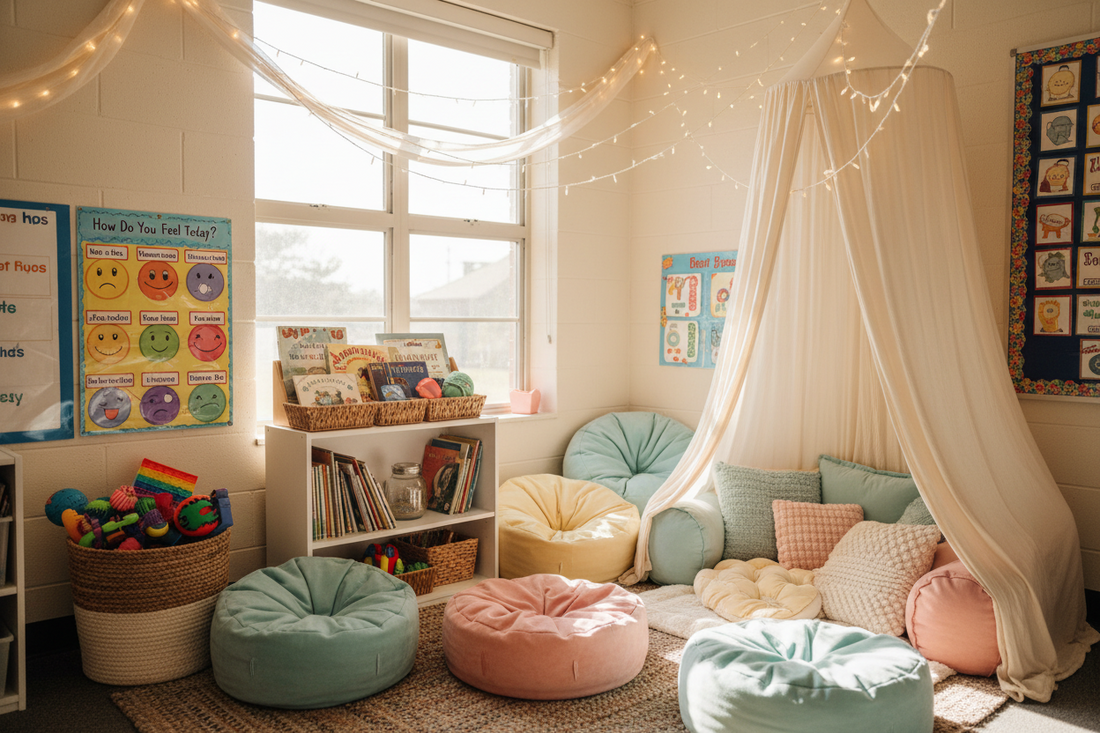
A calm down corner is a small, defined space where your child can go — by choice — to settle their body before rejoining the family. It's stocked with a few simple tools that engage the senses and slow things down. That's it.
What it is not is a time-out spot. This distinction matters more than any cushion or basket you'll buy. If your child is ever sent to the corner as a consequence — “That's it, go calm down” — the space becomes a place they associate with being in trouble, and they'll resist it exactly when they need it most. The goal is self-regulation, not isolation. Over time, a child who learns to notice “I need a minute” and take that minute on their own is building a skill that will outlast tantrums, homework battles, and every hard day still to come. Teachers rely on the very same setup in the classroom — see our calm down corner ideas for the classroom if you'd like the school-day version.
Keep that reframe in your back pocket. Everything below works because the corner stays a safe, inviting place — never a threat.
Step 1: Pick the Spot (Yes, It Can Be Tiny)
Forget the idea that you need a dedicated nook. In a small home, the best calm down corner is often carved out of a space you already have:
A corner of the living room behind the sofa. The end of a hallway. The bottom third of a closet with the doors removed. A window seat. Even a large floor cushion that lives in one consistent spot counts. What matters isn't square footage — it's that the space is defined and consistent. Kids regulate better in a spot that feels contained, and they return more easily to a place that's always in the same corner.
If you truly have no corner to spare, make it portable: a small basket of tools plus a fold-out mat that comes out and goes to the same patch of floor every time. The ritual of setting it up can itself be part of the calming.
Step 2: Mark the Boundary
A defined edge tells your child's nervous system “this is a different kind of space.” You don't need furniture. A small rug or bath mat, a pop-up play tent, a tension rod with a curtain across a corner, or even painter's tape on the floor all work. In a shared or open-plan room, a tri-fold cardboard display board (the science-fair kind) props up in seconds and gives instant visual privacy for a couple of dollars.
Where you can, face the spot toward a wall rather than the room. Reducing visual input is half the battle for an overstimulated child, and a little privacy makes the corner feel safe enough to actually use.
Step 3: Soften the Senses
You're aiming to lower the sensory temperature of the space. Three cheap levers do most of the work:
Something soft to land on. A beanbag, a couple of floor cushions, or a folded blanket. Sinking into something soft gives the body gentle input that helps kids settle — and keeps the corner comfortable enough to choose.
Gentler light. Overhead lights are harsh, especially for sensitive kids. A small battery lamp, a string of warm fairy lights, or a light fabric draped overhead changes how the whole space feels the moment your child steps in.
Lower sound. If the corner sits near kitchen or TV noise, a pair of kid-sized ear defenders in the basket gives your child a volume knob for the world.
None of this has to be new or matched. A blanket from the linen closet and a lamp from the hallway are perfect.
Step 4: Stock a Few Tools That Actually Regulate
Resist the urge to fill a giant bin. Four or five well-chosen tools beat twenty overwhelming ones. Aim for a small mix across the senses:
- A breathing anchor. The single most useful tool in the corner is something that helps a child slow their breath — because a slow exhale is what actually flips the body out of fight-or-flight. A screen-free breathing light gently expands and contracts with a glow, and your child simply matches their breath to the rhythm: breathe in as it grows, out as it fades. There's no app, no screen, and nothing to read, so even a very young or very upset child can use it without a single instruction. Because it works without a device, a Breathing Pal may help support kids who only get more wound up by anything with a screen. It becomes the anchor the rest of the corner is built around.
- Something to squeeze or fidget. A stress ball, a stuffed animal, putty, or a textured cushion — anything that gives busy hands a job.
- Something to look at. A glitter jar, a lava-style bubble timer, or a small “feelings” poster your child can point to.
- Something to hold. A weighted stuffed animal or a small soft blanket offers grounding pressure that many kids find deeply calming.
- A printable card or two. A simple “what can I try?” card walks a child through their options when they're too flooded to think.
If you're building the whole thing from scratch, our calm down kit checklist breaks down every category so you can shop your own house first.
Step 5: Introduce It — Calmly, and Not Mid-Meltdown
Here's a step parents skip: you have to teach the corner before you need it. Introduce it on a calm, ordinary afternoon. Sit in it together. Try the tools. Let your child decorate it, name it (“the cozy corner,” “the calm cave”), and practice using the breathing light when nobody's upset. Ten minutes of low-stakes practice does more than any in-the-moment explanation ever could, because a flooded brain can't learn something new. You're building the muscle memory now so it's there later.
When to Use It (and When Not To)
Use the corner when your child is heading toward overwhelm — the wobbly lip, the rising voice, the “I can't” spiral — and offer it as an invitation: “Do you want to go to your calm corner? I can come with you or you can go on your own.” Younger kids often need you nearby at first; that's normal, and co-regulating alongside them is exactly how they learn to do it solo later.
Don't use it as a threat, a consequence, or a place to “think about what you did.” And don't force it — if your child says no, that's fine. Offer, don't order. The corner is one tool in the drawer, not the answer to everything.
The Common Mistakes to Sidestep
A few patterns quietly sink a home calm down corner. It becomes a punishment spot the moment it's used as one — kids are quick to catalog where “in trouble” happens. It gets overstuffed until the tools themselves are overstimulating; edit ruthlessly. It's introduced during a meltdown instead of before one, so it never gets a fair start. Or it's abandoned after a week because it “didn't work” — when regulation is a skill that takes months of low-key repetition, not a gadget that works on day one. Go in expecting a slow build, and you'll actually get one.
Try a Breathing Break Right Now — Free, No Setup
Not sure your child will take to a breathing tool? You can test the idea in the next two minutes, for free. Our online Playground has a screen-free-style breathing exercise your child can follow along with right now — no app, no download, no purchase. Try it together tonight after the corner is set up, or use it as the gentle sell that gets your child excited to have their very own breathing light in their new cozy spot.
Set up the corner this weekend, keep it small, and remember: you're not building a perfect space. You're building your child a reliable place to land. That's more than enough.
👉 Try the free breathing exercise now at palcompany.co/pages/playground — no app, no download, just a calm minute together.


