
Five-finger breathing and star breathing pair a tracing movement with a gentle breath. One uses the outline of a hand; the other uses a star on paper. This guide offers a script for each, free resources to save or print, and ways to adapt the activity at home or school. Neither requires a child to finish a shape, hold their breath, or feel calm afterward.
Why try a tracing exercise?
A visible path can make a breathing invitation easier to follow. For example, Eling Infant School describes tracing up and down the fingers with the in-breath and out-breath. Treat the shape as a guide, not a timer: the child's comfortable breathing determines how quickly the finger moves.
The NHS recommends gentle breathing without forcing it. No large breaths, long exhalations, or fixed counts are needed here. If your child wants to learn about belly movement first, see our belly breathing guide.
Practice when your child is comfortable and willing. Stop and return to ordinary breathing if they feel dizzy, short of breath, uncomfortable, or more upset. For a child with a breathing condition, ask their clinician about suitable exercises and follow their care plan.
Five-finger breathing
Also called hand breathing or take-five breathing, this version needs only your own hands. A paper outline is an alternative if touching the hand feels distracting or unpleasant.
- Hold up one hand with the fingers comfortably apart, or rest it on a table.
- Place the other pointer finger at the outside base of the thumb. Ask your child whether they want to join or watch.
- Trace toward the thumb tip while gently breathing in. Breathe through the nose if comfortable.
- Trace down the other side while breathing out easily. There is no need to hold at the top.
- Offer the next finger. “Another finger, a break, or all done?” Continue only if the child wants to.
- Finish wherever feels right. Tracing all five fingers gives five complete breaths, but this is not a required target.
A short script: “My finger goes up as I breathe in, and down as I breathe out. I'm going at a comfortable pace. You can try, watch, or stop.” There is no thirty-second deadline.
Download the free Five-Finger Breathing poster (PDF): a big hand to trace with in/out arrows on every finger.

The poster shows the full five-finger route. You can use just one finger; repeating the whole hand is optional.
Star breathing
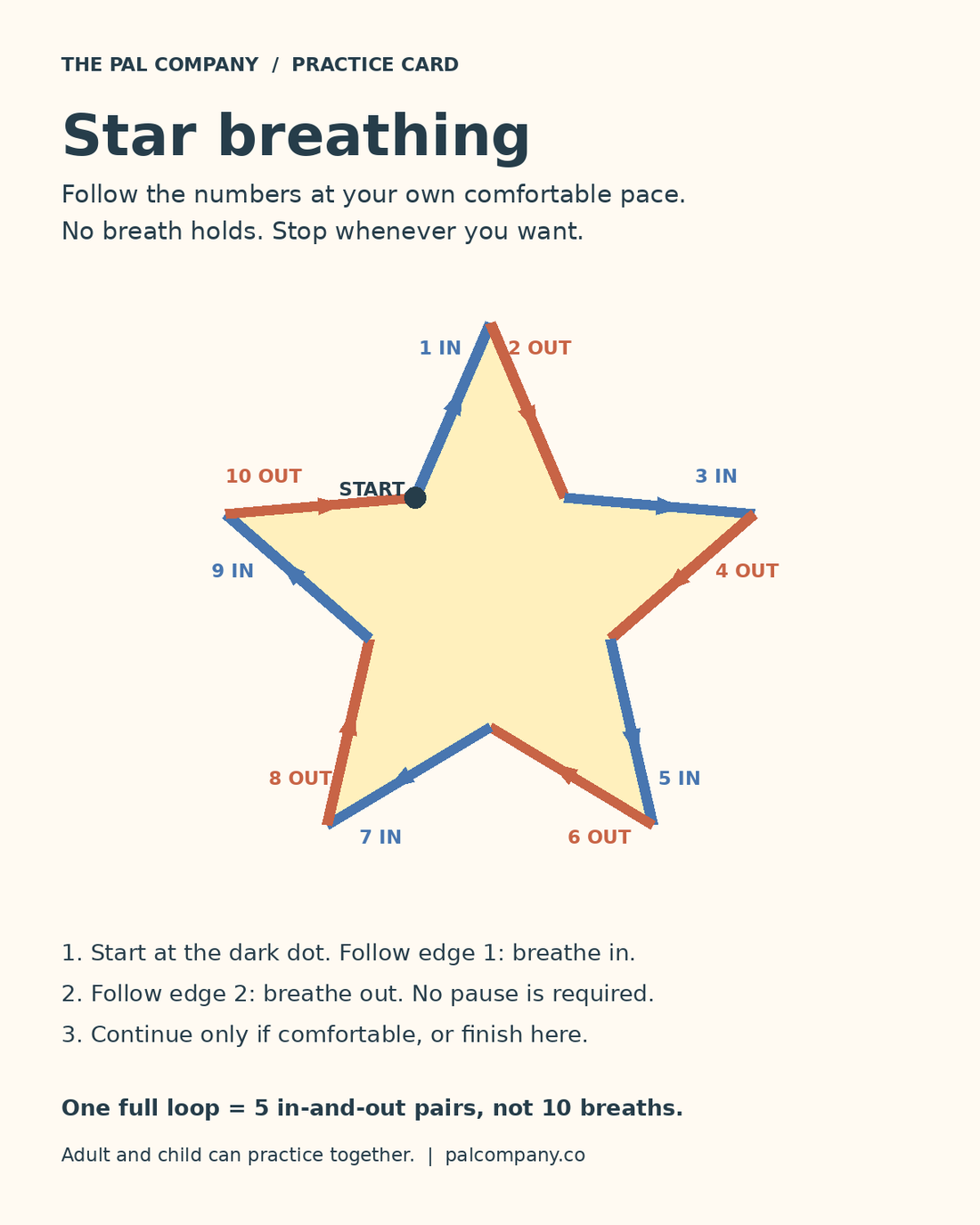
A five-pointed star has ten edges. Alternating one inhale and one exhale across each pair of edges gives five complete breaths, not ten. The numbered card below uses a version without breath holds.
- Start at the dark dot at the inner corner just to the left of the top point.
- Follow edge 1 toward the top point while breathing in gently. The blue color and IN label mark the cue.
- Follow edge 2 away from the point while breathing out easily. It is orange and labeled OUT. No pause is required.
- Continue in number order only if comfortable. Odd-numbered edges cue IN; even-numbered edges cue OUT.
- Stop anywhere or return to the dot. A full loop contains five in-and-out pairs. A partial loop is fine.
A short script: “Follow the next arrow if you'd like. In gently, out easily. We don't have to finish the star.” If coordinating the path and breathing is difficult, trace while breathing normally or watch an adult demonstrate.
Save the free Star Breathing practice card (PNG). Open the image to save it, or print it in portrait orientation using “fit to page.”

Which one, and when
| Choice | Five-finger breathing | Star breathing |
|---|---|---|
| Full route | Five in-and-out pairs | Five in-and-out pairs |
| What you need | A hand or paper hand outline | A drawn or printed star |
| Where to try | Seated together before a story, or at a desk | At a table or a quiet practice space |
| Easy adjustment | Trace one finger, watch, or stop | Trace one pair of edges, watch, or stop |
| Duration | No fixed length | No fixed length |
Offer the choice before starting: “Would you like the hand, the star, or something else?” Neither activity needs to be taught first, and a child does not have to use a breathing exercise when visiting a calm corner.
How to introduce them at home or school
- Teach when calm. Children's Health recommends practicing breathing skills when a child is calm and adapting to their comfort.
- Demonstrate before explaining more. Show one finger or two star edges. Ask whether the child wants another demonstration.
- Use an invitation. “Would tracing help?” leaves room for a different response. Avoid making everyone in a class match one breathing pace.
- Keep a familiar alternative available. Watching, quiet drawing, or sitting with a trusted adult can replace the exercise.
- Make any product optional. The Breathing Pal Mini Kyle offers light-guided breathing modes as a separate visual option. A preset rhythm is not the same as this self-paced tracing activity. Follow its instructions and do not ask a child to stretch or hold a breath to match it.
Mistakes to avoid
- Letting the drawing set a demanding pace. Adjust the finger movement to comfortable breathing, not the other way around.
- Grading shoulder or belly movement. Avoid turning the practice into a performance. Pause if the child feels watched or corrected.
- Requiring completion. One finger or one in-and-out pair can be enough to explore the idea.
- Using it as a consequence. Do not require breathing before a child receives comfort or rejoins an activity.
- Promising instant calm. A child may feel different, the same, or prefer another activity. These are coping options, not treatments.
For another visual route, try our rainbow breathing guide. Keep the choices simple rather than asking a child to learn several exercises at once.
Frequently asked questions
What is five-finger breathing?
A child traces up one finger while gently breathing in, then down the other side while breathing out. A complete hand gives five in-and-out pairs, but the child can stop after any finger.
What is star breathing?
In this version, a child follows a five-pointed star, alternating a gentle inhale and exhale along its ten edges. One full loop is five complete breaths. No breath holds are required.
What age are five-finger and star breathing for?
Readiness and comfort matter more than a fixed age. Let a child watch first, trace only part of a shape, or choose a different activity. Hand tracing is optional if touch or movement feels uncomfortable.
Do these exercises help with anxiety in kids?
Gentle breathing may be a useful coping tool for some children. These tracing activities do not treat an anxiety disorder or guarantee calm. If anxiety persists or affects daily life, speak with the child's pediatrician or a qualified mental health professional.
Which is better, five-finger breathing or star breathing?
Neither is best for everyone. Hand tracing needs no printable; the star gives a visible path on paper. Offer a choice and use whichever feels comfortable, including neither.
Print the star, try the hand
Start with a brief demonstration during an ordinary, settled moment. Ask which option your child prefers, and let their response guide whether you continue.


