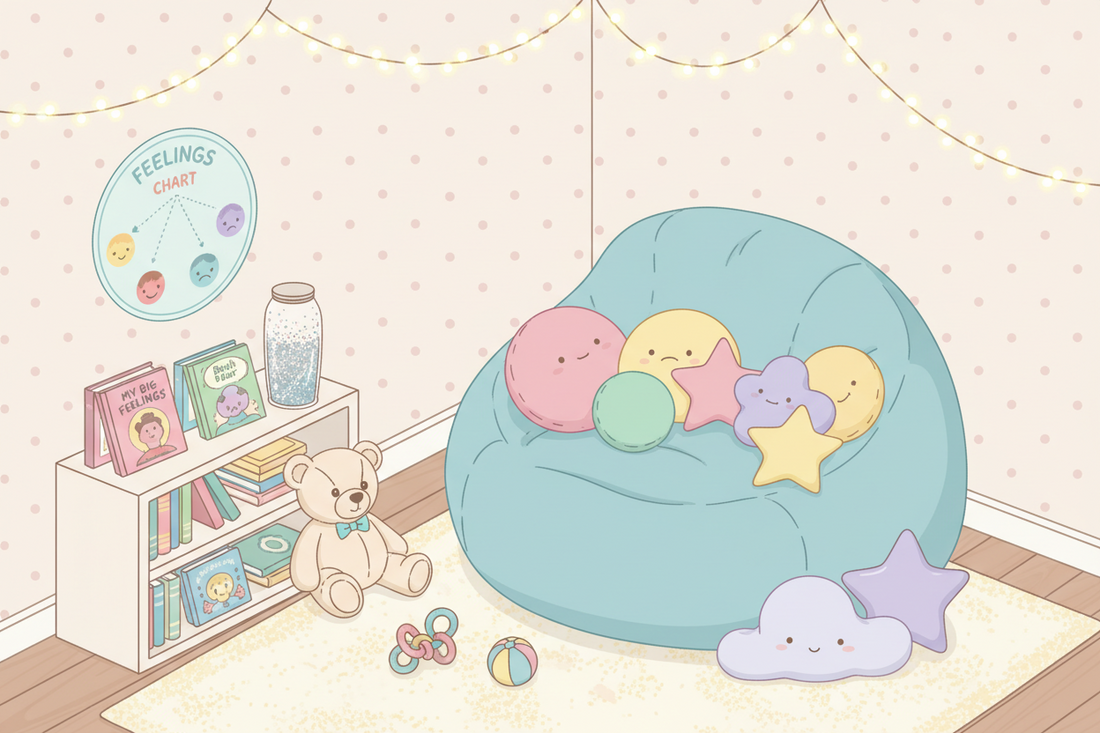
A calm down corner gives a child a place to take a break, with a trusted adult nearby when needed. Familiar pictures can help you show the choices without adding lots of words. These calm down corner printables offer eight options for a home or classroom corner; choose just one or two to introduce first: a steps poster, a feelings chart, a chart for sizing a feeling, cut-out tool cards, and four breathing posters a child can trace. All of them are free PDFs on a standard letter page, with no email address required. Print, laminate if you can, and hang them at a seated child's eye level.
If you are still building the corner itself, start with our parent and teacher guide to building a calm down corner; this page helps you choose and download the visuals.
The 8 printables at a glance
| Printable | What it does | Best for | Download |
|---|---|---|---|
| My Calm Down Steps poster | The 4-step routine: notice, breathe, choose a tool, come back | Practicing a familiar routine together | |
| How Do I Feel Today? chart | Eight faces to point to, plus an "I feel… because…" sentence | Pointing to or naming feelings | |
| How Big Is My Feeling? chart | Small / medium / big, each with a matching action | Talking about feeling intensity | |
| Calm Down Steps & Tool Cards | Eight cut-out cards: the four steps and four tools | Hands-on choosing and adult-managed travel kits | |
| Belly Breathing in 4 Steps | The foundation breath, balloon-style | Trying gentle belly breathing | |
| Five-Finger Breathing | A hand to trace, in up, out down | Children who enjoy tracing a hand | |
| Star Breathing | A star to trace; pauses in tracing are optional | Children who enjoy tracing a shape | |
| Rainbow Breathing | Five arcs to trace, one breath per color | Optional individual or group practice |
1. My Calm Down Steps poster
This is one possible starting point. It shows four actions to explore together: Notice ("something feels too big"), Breathe (five slow belly breaths, following a light or a hand), Choose a tool (one, not five), and Come back ("I'm ready"). The bottom line reminds the child that the corner is a place they choose, not a time-out. Practice together on calm days and offer reminders as needed. The sequence and five-breath count are suggestions, not a test: a child may skip breathing, ask for help, or choose another tool. Rejoining does not require a perfectly calm face.

2. How Do I Feel Today? feelings chart
Eight simple faces (happy, calm, excited, tired, sad, worried, scared, angry) a child can point to, with a sentence frame underneath: "I feel ______ because ______." Pointing may offer another way to communicate when words are hard; naming a feeling does not make it disappear. Use it at the entrance to the corner, at morning meeting, or at the dinner table. In classrooms, offer private, optional check-ins rather than requiring children to display their feelings publicly.

3. How Big Is My Feeling? chart
The feelings chart answers "what." This one answers "how much," and pairs each size with an action: small (a little wobbly: take three breaths), medium (getting bigger: use one tool from the corner), big (too big for me: ask a grown-up for help). Treat these as conversation prompts, not rules for how a child should feel. Adults can help with any size of feeling; children do not have to try three breaths before asking for support.

4. Calm Down Steps & Tool Cards
Eight cards to cut out: the four steps from the poster, plus four tools (squeeze, count to ten, hug yourself, three sips of water). An adult can cut and finish the cards, checking for sharp edges or loose small parts. Keep them in a pouch or on an adult-managed ring, not a cord around a child’s neck. Offer one or two choices when a full poster feels overwhelming; the cards can also travel with an adult. Our calm down kit checklist covers what else goes in a portable kit alongside the cards.

5–8. The four breathing posters
The "Breathe" step of the routine needs a how. These four posters offer picture or tracing cues to try with an adult as needed. Follow a comfortable pace rather than trying to finish a set number:
- Belly Breathing in 4 Steps: the foundation. Hand on the belly, breathe in and make a balloon, breathe out and let it shrink. Teach this first; the full method is in our belly breathing guide.
- Five-Finger Breathing: trace a hand, in on the way up each finger, out on the way down. One hand offers five possible breaths; stop earlier or simply trace while breathing normally.
- Star Breathing: trace a star, in up the blue sides, out down the orange sides, the full outline offers five breaths. Any pause can be a pause of the finger only: keep breathing comfortably and skip breath-holding.
- Rainbow Breathing: trace five arcs, one breath per color. This PDF uses red, yellow, green, blue and purple. Invite children to join or watch; finishing all five is optional.
Try one breathing visual at first and let the child help choose it. Add another only if it is useful. For another visual option, the free guided breathing exercises for kids offer browser-based practice. A screen-free Breathing Pal can provide a light cue, but no product is required and the child need not match a pace that feels uncomfortable.
Before trying a breathing poster
Use gentle, unforced breaths. Skip holds, fixed timing or repetitions that do not feel comfortable; stop if a child feels dizzy or uncomfortable and return to normal breathing. A drawing, quiet company or another familiar activity is also an option. The counts and reassuring phrases on the printable sheets are prompts, not a promise that a child will feel calm after completing them.
These visuals are educational tools, not treatment. If distress is frequent, intense or interfering with daily life, discuss it with the child’s healthcare professional.
Setting up the wall
- Print at 100% on letter paper. Cardstock if you have it; laminate if the corner sees daily use.
- Hang at a seated child's eye level. Check the actual height from the child’s usual seat or cushion.
- Put the steps poster where the child faces when they sit down. Feelings chart at the entrance, breathing poster beside the steps, tool cards in an accessible pouch, with supervision appropriate to the child.
- Introduce the corner on a calm day. Walk through the posters together, practice one breath, pick a name for the space. Offer the corner as a choice, not a punishment, and stay available to help.
- Rotate, don't add. Keep familiar visuals while they are helpful; replace a confusing or unwanted one rather than filling every wall.
For room-by-room ideas, see our guides to a calm down corner at home and 15 calm down corner ideas for the classroom. If you are considering optional tools, check the contents of each Pal bundle before choosing; familiar items you already own are a useful starting point.
Frequently asked questions
What should be on the wall of a calm down corner?
Start with one or two familiar visuals, such as a steps poster and a feelings chart. Add a breathing visual or tool cards if the child finds them useful. There is no required number of posters.
Are these calm down corner printables really free?
Yes. Each one is a PDF link on this page, with no email address or sign-up required. Print as many copies as you need for your home, classroom or counseling office.
What age are these printables for?
Choose by the child’s communication, interests and comfort rather than a fixed age. Younger children may point to a picture with an adult; others may prefer words or tracing. Adapt or skip any activity that is confusing or uncomfortable.
How do I teach a child to use the calm down corner posters?
Practice together on calm days, let the child choose a visual, and offer brief reminders and adult support as needed. Try “Would you like me beside you, or a little space?” Never use the corner as a punishment or require independence before a child is ready.
Can I use these in a classroom?
Yes. Use them at home or in a classroom, introduce them during a calm part of the day, and make participation optional. Keep feelings check-ins private and offer another quiet activity if breathing practice is not a good fit.
Print two today
Start with the steps poster and the belly breathing poster, place them where the child can see them, and explore them together. Keep practicing without pressure and adjust the choices to what your child or class uses. When you want the breathing led by a glow instead of a poster, the Breathing Pal collection offers optional screen-free light cues.


