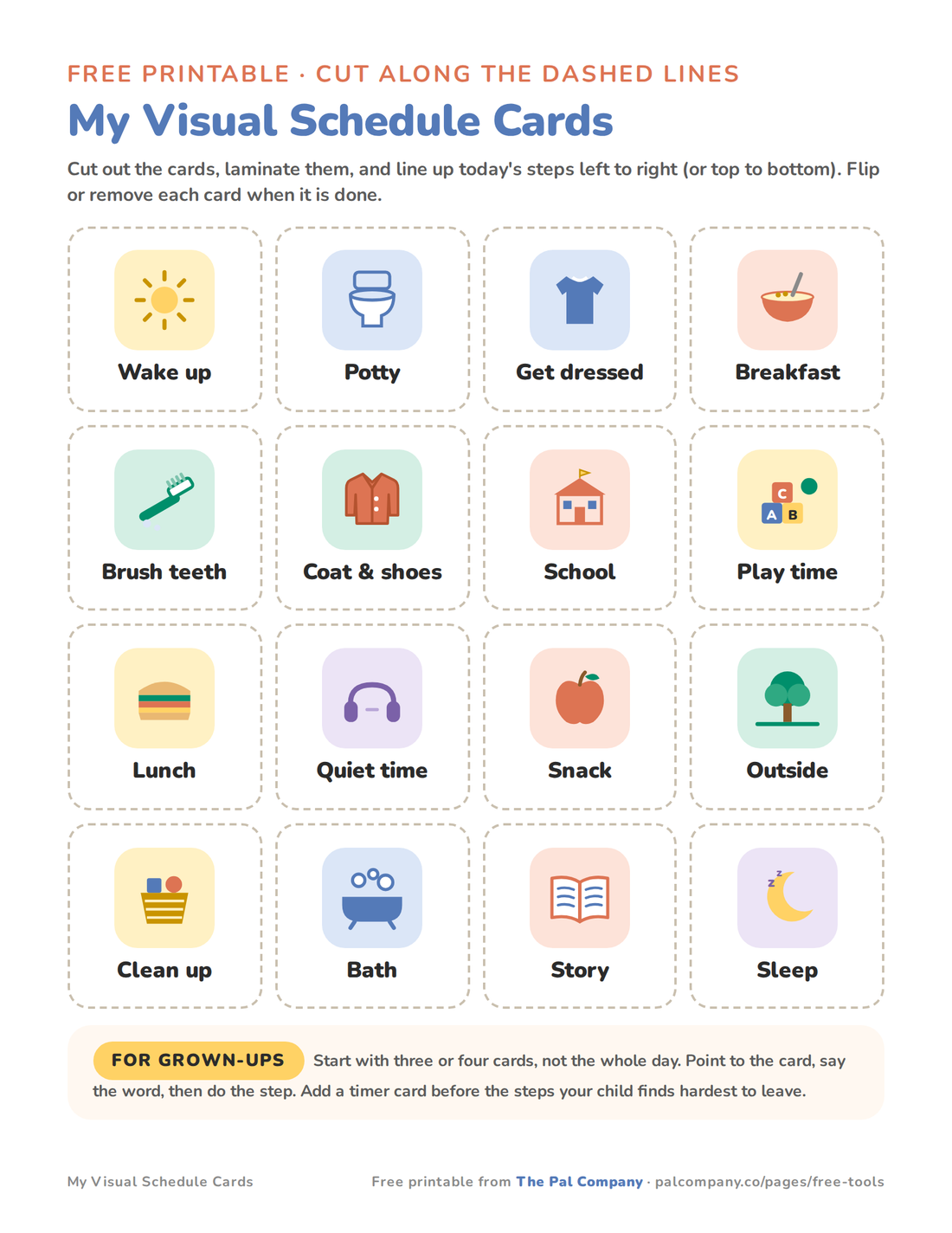
A visual schedule for kids is a row of pictures that shows what happens next. That is the whole idea, and it is surprisingly powerful. Children who cannot yet read a clock or hold a sequence of spoken instructions in their head can look at a picture and know: breakfast, then teeth, then shoes, then the car. Seeing the plan can make the next step easier to understand, though a schedule will not prevent every difficult transition. This guide covers the formats, how to make one, how to teach it so it actually gets used, and a free set of 16 printable picture cards.
Why visual schedules work
Spoken instructions disappear the moment they are said. A picture stays. For a young child, that difference is huge: the schedule holds the plan so the child does not have to, and it lets them check for themselves instead of asking you. Visual schedules can support children who benefit from seeing a sequence rather than relying only on spoken instructions. They are used in early childhood settings and with autistic children, but the format should match the individual child rather than a diagnosis or age band.
Use the pictures as a shared plan, not an authority to argue with your child. Try: "Bath is next. Do you want to carry your pajamas or your towel?" Acknowledge feelings and offer help when a step is difficult.
Four kinds of visual schedule
| Format | What it shows | Best for |
|---|---|---|
| First-then board | Two pictures: the current activity, then the next activity | Toddlers, hard transitions, children new to visuals |
| Now-next-later strip | Three pictures, moved along as the day goes | Preschoolers; days that change a lot |
| Daily schedule | The whole morning, afternoon or day in order | Children comfortable with longer sequences; school days and weekends |
| Routine checklist | The small steps inside one routine (getting dressed, bedtime) | Routines that stall in the middle |
Start smaller than you think. A two-step first-then board can be a manageable starting point; add steps as your child becomes comfortable with the idea.
How to make a visual schedule
- Pick one routine that goes wrong. Mornings, after school, or bedtime. Don't schedule the whole day on day one.
- List the steps as your child experiences them. "Get ready for school" is not a step; "shoes," "coat" and "backpack" are.
- Choose pictures your child recognizes. Simple drawings, photos of your child's own toothbrush and shoes, or printed cards. Try a photo if a drawing is unclear. Some children understand a real object, drawing or written word better; check what the picture means to your child before using it.
- Start with a few steps. Try two to four, then adjust. The right length depends on what your child understands and how much of the routine they want to see.
- Lay it out left to right or top to bottom. Same direction every time, at your child's eye level, where the routine happens.
- Add a "finished" spot. A pocket, an envelope or a "done" column. Moving the card is the satisfying part.

Our free visual schedule cards (PDF) give you 16 picture cards for the steps of a typical day: wake up, potty, get dressed, breakfast, brush teeth, shoes and coat, school, play, lunch, quiet time, snack, outside, clean up, bath, story and sleep. An adult can cut and optionally laminate them, then add hook-and-loop fasteners if useful. Keep small loose fasteners away from children who mouth objects. Car and timer cards are not included; use your own photo or drawing for those steps.
How to teach it
A schedule on the wall does nothing until it becomes part of the routine. There is no fixed learning deadline; introduce it gradually and adjust the support as you go.
- Introduce it when calm. Walk through it together like a game: "First we… then we…" Let your child help put the cards up.
- Use it every time, even on good days. Consistency is what makes it trustworthy.
- Point, say the word, then do the step. Keep your language short: "Teeth." Not a paragraph.
- Let your child move the card. Offer help if needed; moving or flipping it can make completion visible.
- Invite your child to check the schedule. "Let’s see what comes next." Point or read it together if they need help.
Pair it with a timer, if useful
A visual schedule shows what comes next. It does not show when. For steps that tend to drag on (play before school, screen time, the bath that turns into a swimming lesson), put a timer card before the step and use a visual timer so your child can see how long is left. A color-based timer such as the Timer Pal uses changing colors as time passes; explain and practice what those colors mean. A sand timer offers a different visual cue for a fixed interval. Agree on a manageable duration and what happens afterward. If the countdown upsets your child, skip it or try a simple verbal warning. Never use a timer to punish, rush essential care or withhold comfort.

Some families use both tools, while others prefer just the schedule. Our guides to a visual timer for autism and visual timers for ADHD offer additional ways to introduce timers.
A sample morning schedule
Here is what a first visual schedule might look like for a four-year-old whose mornings fall apart somewhere between breakfast and the front door.
- Wake up and potty. The schedule is on the bathroom door, so it is the first thing your child sees.
- Get dressed. Clothes laid out the night before, in the order they go on.
- Breakfast. The card goes on the kitchen fridge copy of the schedule, or your child carries it to the table.
- Brush teeth. An adult helps with brushing; a timer can be an optional cue, not a test of independence.
- Shoes and coat. The card is by the front door, at floor level.
- Car. The last card, and the one that gets the biggest "done!"
Notice what is missing: play. If your child can be dressed and fed with ten minutes to spare, add a "play" card before "shoes and coat" with a timer card in front of it. Include play because it belongs in the day, not as a guarantee of faster compliance. Preview the end of play and help your child make the transition. Our guide to morning anxiety in kids has more ideas for children who find mornings hard for reasons beyond logistics.
When your child ignores the schedule
It can happen at any point. Treat it as information about what needs adjusting, not defiance. A few things to check:
- Is it where the routine happens? A schedule in the hallway does not help in the bathroom.
- Are you still using it yourself? If adults stop referring to it, so do children. Keep pointing to it, even when you could just say the instruction.
- Is one step the problem? Often the schedule works except for one step that is genuinely hard (leaving play, getting into the bath). Ask what feels difficult, check for sensory discomfort or unmet needs, and offer help. Smaller picture steps or a first-then card may make the plan clearer.
- Does your child have a say? Let them choose the order of steps where the order does not matter, or pick which pajamas card goes up. Ownership matters.
Common mistakes
- Too many steps at once. Start with three or four and grow.
- Pictures that are too abstract. If your child doesn't recognize the icon, switch to a photo.
- Using it only when things go wrong. It may start to feel like a correction rather than helpful information. Use it on good days too.
- Never changing it. When the day changes, change the schedule, and show the change before it happens: "Today, no school. Grandma's house."
- Forgetting the fun steps. Play, snack and story belong on the schedule too. A schedule that is all chores is easy to resist.
Visual schedules for specific routines
Bedtime is one possible place to start; our toddler bedtime routine chart is a ready-made six-step schedule with check-off circles. Mornings are next, and in classrooms, teachers often use a daily schedule on the board plus a timer for each transition, as in our guide to classroom visual timers.
Further reading
For practical guidance on introducing visuals, see the National Center for Pyramid Model Innovations. Vanderbilt TRIAD describes different visual formats, and CU Denver explains pairing timers with schedules. These resources do not endorse TPC products.
Frequently asked questions
At what age can a child use a visual schedule?
Start when the child can connect a picture or object with an activity, with adult support. Try two familiar steps first. Choose the number of steps and type of visual by the child's understanding rather than age alone.
Are visual schedules only for autistic children?
No. Visual schedules are also used in preschool and kindergarten routines. Their usefulness depends on whether the child understands the visuals and finds the information helpful; a diagnosis is not required.
Should I use photos or drawings?
Use what your child understands. Try a photo of their own toothbrush or shoes, a simple drawing, a written word or a real object. Check the connection together rather than assuming one format is best for every child.
How long until a visual schedule works?
There is no reliable deadline for every child. Look for small signs, such as recognizing a card or checking the next step with less help. If it is confusing or upsetting, simplify it, change the visuals or ask the child's teacher or clinician for individualized support.
Start tonight
Print the cards, pick the three or four steps of tonight's bedtime, and put them on the wall where bedtime happens. Walk through it once as a game, then keep using it together with reassurance and help. Add an optional timer cue only if your child finds it useful.


