
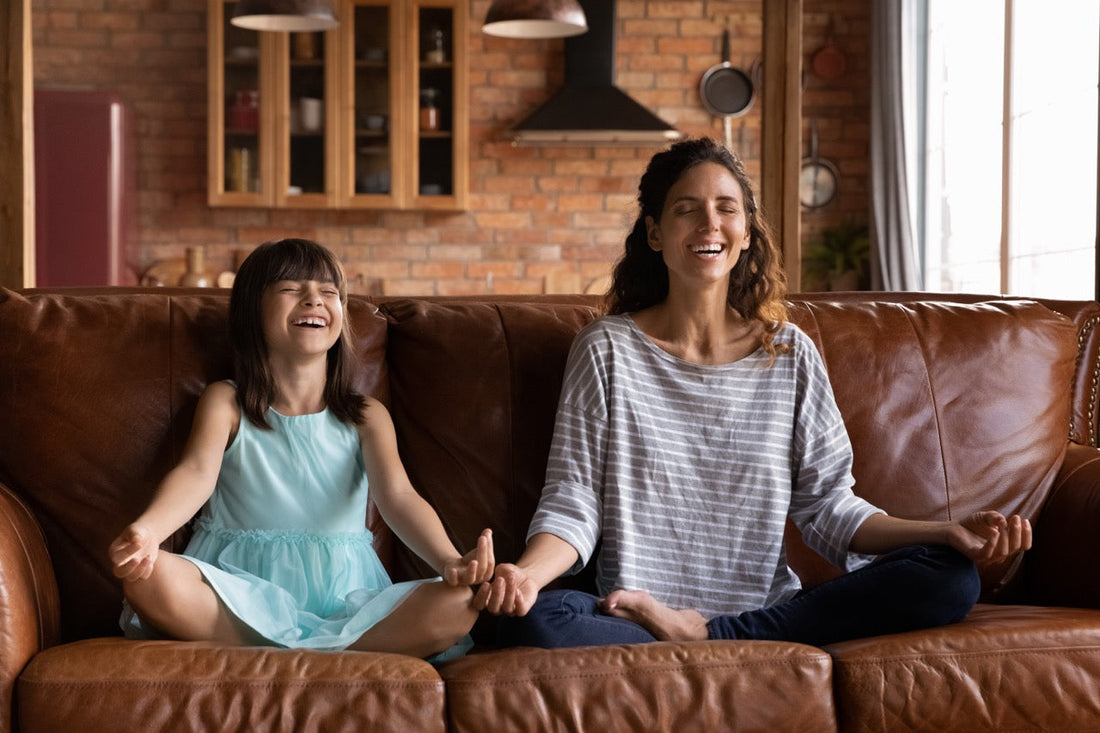
You've heard it from teachers, pediatricians, and every parenting account on the internet: kids should practice deep breathing. But between the buzzwords, it's fair to ask — what does mindful breathing actually do for a child? Is it a real skill with real benefits, or just something we say to buy ourselves thirty seconds of quiet?
Short answer: it's real, the benefits show up in surprisingly practical places, and the earlier a child learns it, the more mileage they get. Here's what changes when kids learn to breathe slowly on purpose — and how to get those benefits without turning your living room into a meditation retreat.
First, what "mindful breathing" means for a kid
For an adult, mindful breathing might mean ten silent minutes on a cushion. For a child, it's much simpler: noticing the breath and slowing it down — especially the exhale — for even a handful of breaths. Smelling the flower, blowing out the candle. Watching a light glow bigger and smaller. Tracing a square in the air. That's it. No cushion, no mantra, no app.
That simplicity matters, because the benefits below don't come from long sessions. They come from short, repeated practice woven into ordinary days.
Benefit 1: A body that can actually calm down
When big feelings hit, a child's nervous system floors the accelerator: racing heart, shallow breath, tense muscles. Slow breathing — especially a long exhale — is the most direct lever a child has to press the brake. The heart rate settles, muscles soften, and the wave passes sooner.
What this looks like in real life: the meltdown that lasts four minutes instead of twenty. The car-seat protest that de-escalates. The bedtime worry spiral that loses steam. Kids who have a practiced breathing skill recover from upsets faster — not because they feel less, but because their body knows the way back down.
Benefit 2: Better sleep, gentler bedtimes
Sleep needs a calm body to land on. A few slow breaths as part of the wind-down routine cue the body that the day is done — which is why techniques with extra-long exhales (like 4-7-8 breathing for older kids) have earned their reputation as bedtime tools. Families who anchor three slow breaths to lights-out consistently tell us bedtime got less sticky within a couple of weeks.
Benefit 3: Focus that comes back after it wanders
Attention is like a puppy — it wanders off, and the skill is bringing it back. A short breathing pause is exactly that practice: notice, return, notice, return. Teachers use one-minute breathing breaks before tests and after recess for a reason: a class that takes ten slow breaths together settles into work noticeably faster. At home, the same trick helps with homework transitions — a "reset breath" between play mode and work mode.
Benefit 4: Feelings get names instead of just volume
Pausing to breathe creates a tiny gap between feeling and reaction — and in that gap, kids (with practice and coaching) learn to say "I'm frustrated" instead of throwing the toy. This doesn't happen overnight, and breathing alone doesn't do it; it happens because the pause makes room for the words. Over months, that gap is where emotional vocabulary and self-control grow.
Benefit 5: A confidence skill they own
There's something quietly powerful about a child discovering they can change how they feel — by themselves, with nothing but their own lungs. Kids who've practiced breathing skills walk into hard moments (first days, doctor visits, big games) with a tool in their pocket. That sense of "I can handle my feelings" may help support kids who lean anxious, and it's a life skill that transfers everywhere: school now, exams later, adulthood eventually.
One honest boundary: mindful breathing is a wonderful everyday skill, not a treatment. If your child's worry, sleep, or attention struggles feel bigger than everyday-sized, your pediatrician is the right first call — breathing tools can sit alongside professional guidance, never instead of it.
How to actually get these benefits (the 2-minute version)
The research on habits and the experience of thousands of families agree: tiny and daily beats long and occasional. Three slow breaths before dinner. One round of box breathing after school. Rainbow breaths in the bath. Pick one anchor moment, attach one small practice, and let it compound.
Two things make practice dramatically easier. First, pick the technique that fits your child's age — our age-by-age guide walks through rainbow, box, and 4-7-8 breathing with scripts for each. Second, give young kids something to follow with their eyes: counting is abstract, but a visible rhythm is not. That's the whole idea behind our Breathing Pal — a soft glowing friend that "breathes" so kids can match it, screen-free, one button, no apps.
Start with one breath tonight
Mindful breathing won't make your child a different kid — it makes them more able to be themselves on hard days. Calmer recoveries, easier bedtimes, steadier focus, feelings with names, and a skill that's theirs for life. All of it starts embarrassingly small: one slow breath, taken together, tonight.
Want a friendly guide for the first try? Our free Pal Playground runs guided breathing right in your browser — no downloads, no signup. Press play, and breathe with your kid.


