
Walk down the night light aisle and you will find cool white, warm white, rainbow-cycling, and a growing shelf of red ones that promise better sleep. The red light vs white light night light debate has real research behind it, and also marketing that outruns the evidence. Here is what light research can tell parents, what it cannot establish about a toddler's sleep, and how to check the light you already own.
The short version
If your toddler sleeps comfortably without a night light, there is no need to add one for a supposed sleep benefit. If light is needed for reassurance or a clear walking route, keep it low, indirect, and sufficient for that purpose. A dim red or amber setting is a reasonable option, but color alone cannot predict the effect on sleep.
Do not assume that a red lamp treats sleep problems, that every white lamp is equally disruptive, or that “670nm” proves a product is safe or effective for every child. Brightness at the eyes, timing, duration, and the lamp's actual light output all matter.
What the research says
Color: short wavelengths are a stronger circadian signal
A 2001 human laboratory study of melatonin suppression found strong sensitivity to short-wavelength light. This helps explain why reducing blue-rich light at night is commonly recommended. However, the study measured a physiological response under controlled conditions; it was not a trial showing that a particular red night light makes toddlers sleep longer.
White light contains a mixture of wavelengths. Its composition varies between products, so calling every white light “a blue light” is too simplistic. Red and amber options generally contain less short-wavelength light, but a color name or photograph is not a measurement of the light reaching a child's eyes.
Brightness: dim matters, but it is not a guarantee
In a 2022 study of 36 healthy children aged 3.0–4.9 years, one hour of evening light exposure suppressed melatonin across the tested range of 5–5,000 lux. The response did not rise in a simple step-by-step way with brightness. The study compared light intensities, not red versus white consumer night lights, and it does not establish a universally safe bedroom brightness.
The useful takeaway is to limit unnecessary evening light, rather than assuming a lamp is harmless because it looks dim to an adult. A measured change in melatonin also does not, by itself, tell us how much a particular child's sleep will change.
What has not been shown
The studies above do not prove that a red night light improves sleep in a toddler who already sleeps well in darkness. They also do not establish a best wavelength, a guaranteed settling time, or a fixed ranking of every commercial lamp. Treat a night light as a practical lighting choice, not a sleep treatment.
Night light colors compared
| Light option | What to consider | A practical choice |
|---|---|---|
| Cool white / daylight | Often has more short-wavelength content than warm white; output varies. | Avoid using bright room lighting for a brief nighttime check. |
| Warm white | Still contains short wavelengths, but the amount and brightness vary. | Check dimming and placement before assuming it must be replaced. |
| Red or amber | A reasonable low-light option; not evidence of better sleep by itself. | Use only enough light for the purpose, away from direct view. |
| Blue, purple, or changing colors | Appearance alone does not measure circadian impact; changing colors may draw attention. | Keep play lighting separate from the quiet nighttime setup. |
| No night light | Appropriate if the child is comfortable and nighttime access is safe. | No need to add a lamp as a sleep aid. |
Does a toddler need a night light at all?
A light can be useful for fear of the dark, a route to the bathroom, or a caregiver's nighttime check. The American Academy of Pediatrics suggests a dark sleep environment and, for a child who fears the dark, a hall night light near the door. This offers a starting point without lighting the whole bedroom.
Ask what your child needs to see. “Would it help to see the doorway?” is more useful than insisting on a color your child dislikes. A lamp does not replace listening to their fear or providing reassurance.
How to choose and place a toddler night light
- Start with its purpose. Is it for finding the door, reassurance, or a brief check? Illuminate that area rather than the whole room.
- Check from the child's position. Look toward the light from mattress height. Move it to a stable location away from direct eye-level glare, while keeping walking routes clear.
- Try the lowest useful setting. Adjust only enough to meet the need safely. There is no visual “doorway test” that proves zero effect on melatonin.
- Choose a predictable mode. A steady red or amber option may be worth trying. A dim existing lamp may already meet the practical need; an upgrade is not automatically necessary.
- Check the timer for the selected mode. Auto-off can reduce unnecessary light, but it may not suit a child who needs ongoing reassurance or a visible route. Explain what will happen and reassess if darkness after shutoff is upsetting.
- Follow the product instructions. Observe age guidance, charging instructions, and placement requirements. Keep cables out of reach, do not place lights under bedding, and do not assume a soft or battery-powered lamp is suitable for unsupervised handling.
A product example: check the mode, not just the color

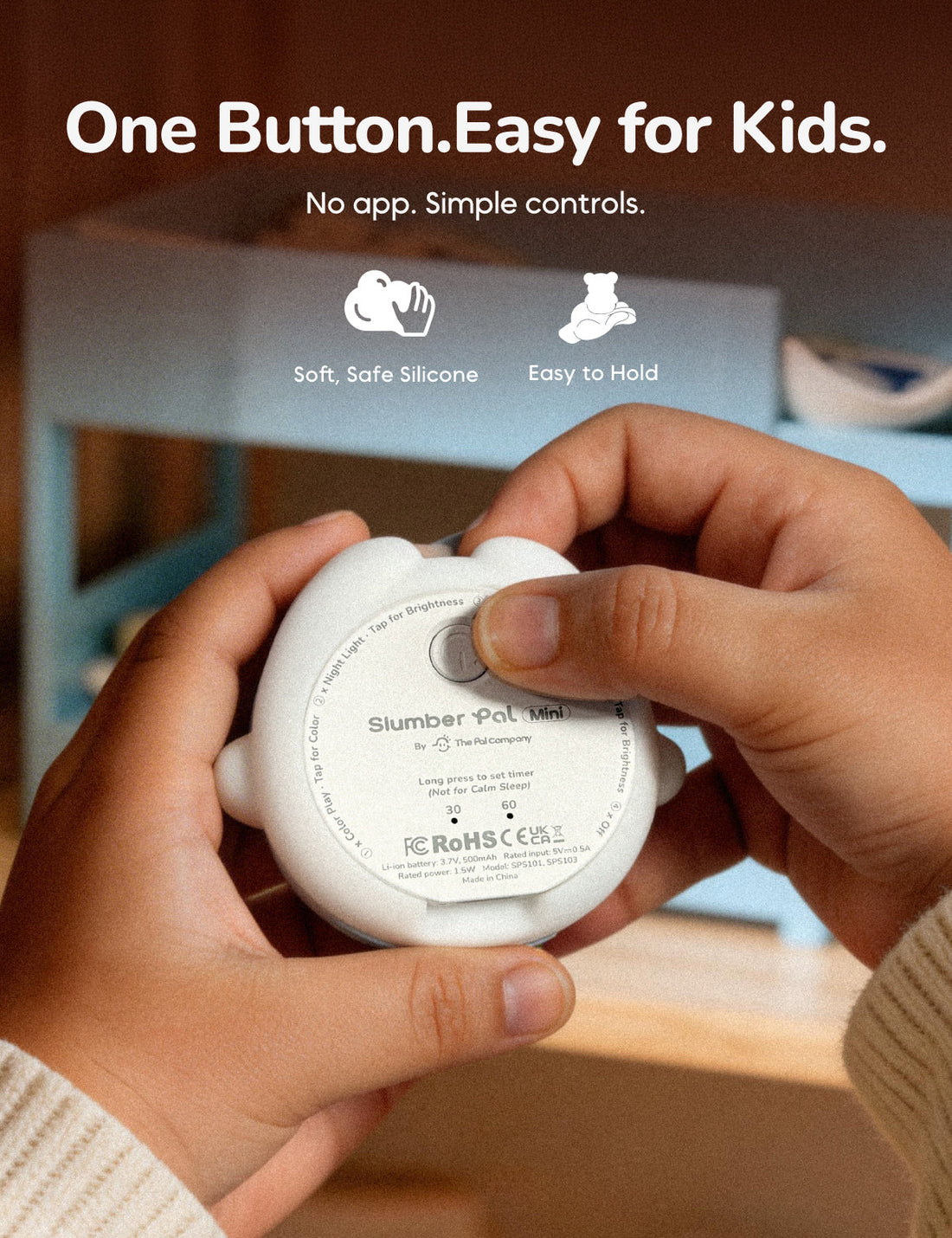
Our Slumber Pal Mini Kyle lists color-play, night-light, and 670nm red-light modes. Its product description specifies a 30-minute auto-off for red mode and 30/60-minute timer options for night-light and color-play modes. Do not assume that selecting a 60-minute timer applies to red mode.
These are product specifications, not clinical evidence that this lamp improves toddler sleep. The wavelength label is not a complete safety assessment, and this article does not recommend red-light therapy devices for bedtime.
Light is one piece of the bedtime picture
Keep the wider routine familiar. Our toddler bedtime routine guide can help organize the sequence. If your child enjoys a quiet activity, our bedtime breathing guide offers optional, self-paced exercises without required breath holds. Neither needs to become a test your child must pass before getting comfort.
Persistent sleep difficulties, snoring, breathing concerns during sleep, or significant daytime sleepiness deserve a conversation with your child's pediatrician rather than repeated changes of lamp color.
Frequently asked questions
Is a red night light better than white for toddlers?
Dim red is a reasonable option when light is needed, because short wavelengths are a stronger circadian signal. That does not prove every red lamp is better than every white lamp or that switching will improve a toddler's sleep.
Should a toddler sleep with a night light on all night?
There is no one rule for every family. Consider reassurance and safe nighttime movement, use only the light needed, and check whether an auto-off setting suits the child.
Is 670nm red light safe for kids?
A wavelength number alone cannot answer that. Safety also depends on the device, output, exposure, and correct use. Follow the manufacturer's age and use instructions; do not substitute a high-intensity therapy device for a night light.
A quick check for tonight
- Identify what the light needs to illuminate.
- Check glare from the child's sleeping position.
- Choose the lowest useful steady setting.
- Confirm what the selected mode does when its timer ends.
- Keep the lamp and charging cable in an appropriate, safe location.
Change one practical feature at a time and notice comfort and nighttime needs. You do not need to buy a new lamp solely because its packaging promises better sleep.


